Two-Layer Compensation: What Road Cycling Teaches About Pay Design
Last time, I wrote about the "Senior Supporter" hypothesis -- giving name and role to people who step back from management, turning "demotion" into "transition."
But name and role alone aren't enough. The compensation problem remains.
I honestly wrote that this was the hardest part. But when I looked into road cycling's compensation structure, I found a surprisingly insightful design.
Road Cycling Has a Two-Layer Compensation Structure
In professional road cycling, the compensation structure is clearly differentiated between the ace (team leader) and the domestiques (gregarios).
First, prize money. It's customary for race winnings to be distributed equally among team members. Whether the ace wins or the domestique sacrifices their body as a windbreaker, the prize share is the same. The fruits of short-term results are shared regardless of role.
Base salary, however, is a completely different story. There's a significant gap in annual salary between ace-level riders and domestiques. Between a top ace and a mid-tier domestique, the difference can be several-fold.
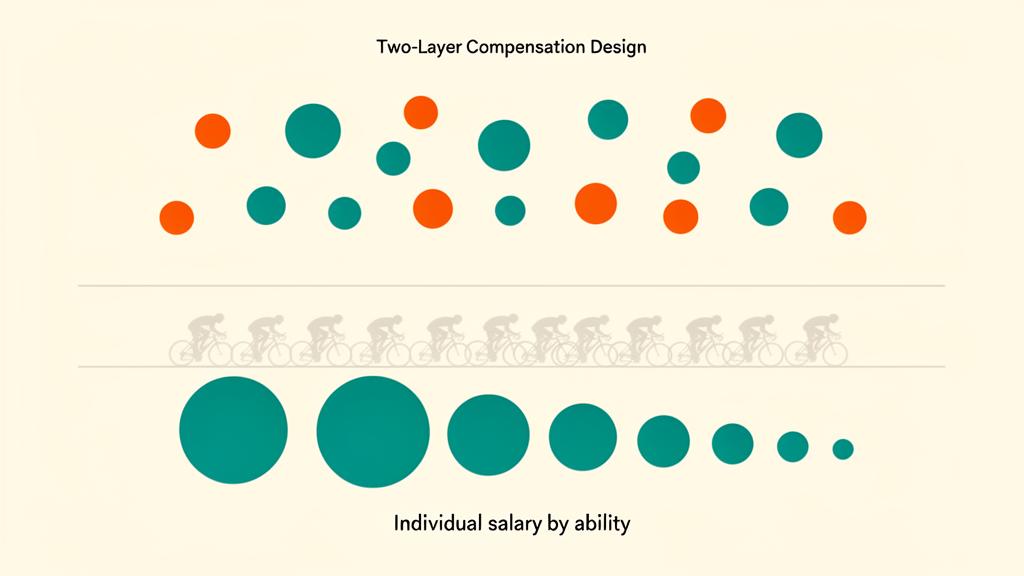
In other words, road cycling compensation has two layers:
Short-term performance rewards (prize money) → equally distributed within the team.
Base compensation (annual salary) → differentiated by ability, track record, and role.
This two-layer structure supports the "acceptance of being a domestique." Short-term victory fruits are shared equally, while long-term career value accumulates based on individual capability.
How Do Former Aces Accept Becoming Domestiques?
This was the point I was most curious about.
In the context of the previous article, it directly addresses the question: "How does someone who goes from manager to Senior Supporter accept a potential pay change?"
In road cycling, transitions from ace to domestique aren't actually that common. Many domestiques build their entire careers in that role. But looking at what transitioning riders have said, three logics of acceptance emerge.
First: the feeling of "shared victory."
One rider put it this way: when the ace wins, it's everyone's victory. The subject of winning shifts from "me" to "the team." This isn't empty idealism -- it's a statement that comes from the visceral experience of physically putting your body on the line in support during a race.
Second: the pragmatic calculation of "career longevity."
Some riders who know firsthand the toll of being an ace view the transition to domestique as a rational choice. When you want a longer career, the domestique position is optimal. This is less an inspiring story and more a very clear-headed decision.
Third: "release from pressure."
Being an ace means carrying enormous pressure. It's mentally grueling, and it can rob you of the ability to see the bigger picture during a race. Moving to a domestique role brings release from that pressure and a different perspective.
What these three patterns tell me is that acceptance isn't built by compensation alone.
What Would This Look Like in Organizations?
Let me map road cycling's two-layer structure directly onto organizations.
Short-term performance rewards (bonuses/incentives) → near-equal distribution across the team.
Whether you're a manager or a Senior Supporter, the team shares the fruits of collective results. Bonuses don't swing dramatically based on "who was at the front this quarter."
Base compensation (monthly/annual salary) → designed on two axes: depth of experience × current role.
This is the key. A Senior Supporter has moved from "front" to "back" in terms of position, but their base compensation level is maintained through depth of experience. "Three years of management experience" doesn't disappear when you become a Senior Supporter. In fact, that experience is the very source of the Senior Supporter's value, so reflecting it in compensation is natural.
The traditional single-axis design of "title = pay" means pay drops the moment a title is removed. But with a two-axis model of "experience depth × role," a design where compensation levels are maintained through transition becomes viable.
The Difficulty That Remains
Having written this far, I feel the system design logic holds together fairly well. But honestly, something still nags at me.
The reason acceptance works in road cycling isn't just the compensation design.
Something more fundamental is at play: the cost of being at the front is visible to the entire team. Domestiques watch in real time as the ace nearly collapses at a mountain summit. Because exhaustion is physically visible, empathy emerges, and "supporting" feels genuinely meaningful.
In organizations, where does a manager's exhaustion happen? In meeting rooms. In one-on-ones. Caught between the executive team and their reports. Team members only see results.
If the process of exhaustion isn't visible, respect for "the cost of being at the front" is hard to cultivate. Without that respect, the value of "being in the back" is hard to appreciate.
Even with the right systems, if this invisibility problem isn't solved, the culture may never take root.
Systems and Culture Only Work as a Set
Let me summarize what emerged in this article.
As a compensation design, the two-layer structure of "equal sharing of short-term results × base compensation grounded in experience depth" can largely solve the pay problem associated with transitioning to Senior Supporter.
But that alone isn't enough. As long as a manager's exhaustion remains invisible to the team, respect for "the supporting role" won't emerge. Systems without culture remain theoretical.
So how do you build that culture?
Next time, I'll shift the angle and think about "taking off the manager's armor." Robert Kegan's developmental theory connects here.
Previous article:

シニアサポーターという役割設計 ―「降格」を「移行」に変える
Next article:

マネージャーの鎧を脱ぐ ― キーガンの発達理論との接続

Was this article helpful?

If this article helped you organize your thoughts
a coffee-sized support would be much appreciated.
※ This is separate from tipping, but—
If you'd like to organize similar themes in your own context, I also offer dialogue sessions as a form of thought organization.
Recommended for you