
The Origin of My Reflection Research - From Elementary School to Today
Introduction
Hello, I'm Takashi Yuto, a specialist in reflection who transforms worries and anxieties into positive action.
I research organizational theory, particularly reflection, and develop web services and host workshops.
On this blog, I share information about organizational theory and practical methods for reflection that I'm learning daily, along with lessons from my work. Drawing from my career as an engineer, I also post about IT automation.
https://www.tielec.net/
Why Do I Research Reflection?
Recently, when meeting various people, I'm often asked: "Takashi, what inspired you to focus on reflection and start working on it?" So I want to articulate why I focus on reflection and what drives my activities.
This may be a somewhat unstructured piece. Please bear with me. If you just want the summary, please scroll to the bottom.
Elementary School - My Future Dream
Since elementary school, I admired business leaders. There was also a time when I thought pilots were cool, but my core vision was always about becoming a business executive. I imagined myself at the top of a large company, moving society. I thought it was amazing and cool. I wanted to become a company president when I grew up and do something significant to contribute to the world.
Middle School, High School, and Gap Year - What Do I Want to Learn?
I entered middle school with this vague dream of becoming a business leader. But my vision was still fuzzy. Still, I thought I should probably go to university to become a business leader, so I decided to aim for high school with college in mind.
After entering high school, I joined the badminton club. School life was so fun that I slacked off on studying. I particularly neglected Japanese and English, and my grades weren't good. However, I enjoyed subjects like geography and political economy, and actually liked studying those. Despite this high school life, I still wanted to become a business leader, so I chose universities based on what I could learn, focusing on business administration, with economics and commerce as alternatives.
While I had decided what I wanted to study, the consequences of slacking off caught up with me. My grades were fine in social studies but terrible in Japanese and English, and I failed the university entrance exams. If you want to go to a humanities-focused university, you can't avoid English and Japanese. I think the failure was because I couldn't find a purpose in studying those subjects.
After a gap year, I was accepted to university.
University Days - What Kind of Work Do I Want to Do?
I got into the business administration department as I hoped.
However, I couldn't get into my preferred level of university, and I had what you might call an academic inferiority complex. Entering university with this complex, I thought I needed to study harder to stand out, so I started studying accounting. Why accounting? Because I thought becoming a certified public accountant would help me prove myself. This was quite different from my original dream of becoming a business leader, and my thinking was distorted. I was driven by wanting to prove myself rather than pursuing what I truly wanted, so my motivation didn't last and I gave up midway.
While studying accounting, around autumn of my sophomore year, it was time to choose a seminar. This was another good turning point for me. Choosing which seminar to join felt directly connected to my life, so I had a conversation with myself. I was torn between an information processing seminar with a relatively gentle professor and an organizational theory seminar known for being extremely demanding. The information processing seminar would be useful after entering society, while the organizational theory seminar might not have immediate applicability but could help me grow through a challenging environment. In the end, I chose the organizational theory seminar. "When in doubt, choose the harder path, the one that helps you grow" - that's how I decided.
From my junior and senior years, I devoted much time to seminar activities. Since this was a field I was originally interested in, I enjoyed the studies. During this period, while studying organizational theory, I actively read books by business leaders, academic books and papers on management, and economic magazines. I realized that when studying something I love, I can become absorbed and concentrate better than others. While it was a good environment in terms of studying my favorite field, the demanding seminar still caused stress.
Then came job hunting season. I still had thoughts of starting my own business someday, but I believed I needed to first learn about organizations at a practical level. So I job hunted wanting to learn about organizations and management more concretely through consulting work. At the time, I didn't have a specific consulting area in mind, so I applied to various consulting positions - organizational consultants, IT consultants, HR consultants, and more. In the end, I decided to join an IT package vendor. At that time, I believed I would work as a consultant.
Professional Life Part 1 - Working for Growth
After graduating, I joined an IT package vendor. At this company, assignment was determined after a training period. I took the training thinking I would become a consultant, but I was assigned to the product quality evaluation department - specifically, the software product testing department. Although it wasn't my desired assignment, I thought it was fate and decided to give my all to the work in front of me. I figured if I developed enough skills to be confident about changing jobs, I'd have more options later. I worked desperately throughout my twenties with that mindset. At that time, rather than thinking deeply to produce results, I worked somewhat blindly, solving things with time.
The company had frequent organizational changes, so I experienced role changes every one to two years. I went through test engineer → backend engineer → infrastructure engineer → operations engineer. As someone who gets bored easily, changing roles was actually welcome - whenever I started feeling bored, my role would change, keeping things fresh. The broad experience I gained as an engineer has become valuable to me today.
Professional Life Part 2 - Dilemma, Exhaustion, Rest, and Awareness
About five years into my engineering career, I was given the role of team leader. For the first six months or so, even though it was a small team, I was excited to be in a position to actually move an organization. While working with my own vision of what kind of team I wanted to build, cracks started appearing after about six months. I couldn't resolve the conflict between what the organization required and what I believed should be done, and I became exhausted.
The result? I had a mental breakdown and took about three months of leave. If I had to put my feelings into words, "battery dead" would be the most fitting expression. I wanted to turn the switch on, but there was no energy left. Looking back, I think it was a message telling me to slow down and take time to really face myself. Until then, I had been working while depleting my emotional reserves, and this made me realize I couldn't continue like that. During my leave, spending slow and quiet time gradually restored my emotional balance. This period became valuable time to face myself, which I hadn't really done before. This experience was one of the triggers that made me realize the importance of reflection.
Professional Life Part 3 - Encountering Reflection
Having faced my heart and recovered, I was able to return to work. For about three months after returning, I worked as a team member rather than in a management position. Soon after, I was transferred to a new department and given leadership of an SRE team. I had been thinking of leaving after about 10 years at the company, and during this period my thoughts became clearer. With three years left until I would leave, I thought it was time to seriously consider how to move to the next stage, and I decided to prepare as much as possible.
While I had always wanted to become independent, I hadn't deeply explored what specific field I would provide value in. So the first thing I decided to start was sharing information. I thought that sharing information about my engineering expertise would be valuable for the future, which is why I started this blog.
This was the first article I wrote:

スマホゲームで例えるSRE
Meanwhile, since I was involved in team management and had aspirations of becoming a business leader, I was actively consuming information about organizational management and sharing my philosophy with team members. That's when I encountered the book "Reinventing Organizations." I strongly resonate with the philosophy of Kazuo Inamori, founder of Kyocera, and when I read "Reinventing Organizations," I thought this was exactly what Inamori had been thinking and practicing for years. The book mentioned "reflection" as an important keyword for building teal organizations. It described reflection as deeply facing oneself, and I strongly felt that this was exactly what I had been doing during my leave.

「ティール組織」と「アメーバ経営」 の意外な関係とは!?
Professional Life Part 4 - Researching Reflection, New Discoveries
Having become strongly interested in the word "reflection," I wanted to know more specifically what reflection is, so I started searching Google and reading books about it. The book that particularly influenced me during this time was "Integral Theory: A New Model of Growth for Reading a Diverse and Complex World." I came to strongly feel that reflection isn't just about individual issues - it's important to approach it while being aware of connections with colleagues and society.
This is the first diagram I drew with that image:
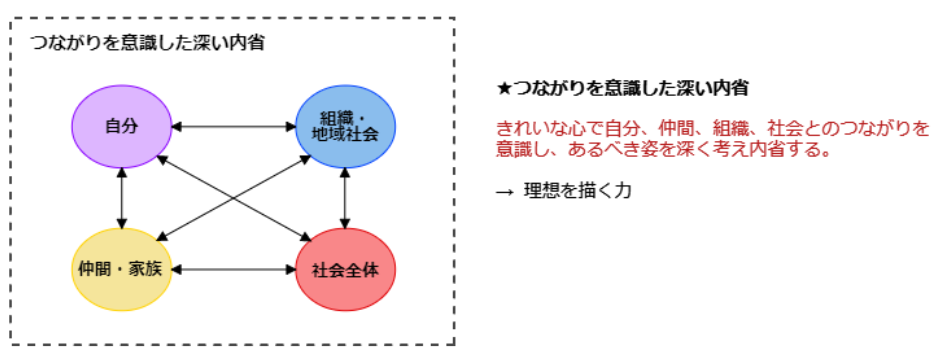
From there, I started looking into how to do reflection effectively. What I realized was that there wasn't much available on how to actually do reflection. So I thought, why not create my own solution for effective reflection. I started by creating a worksheet for reflection in Excel. After repeatedly using and revising the worksheet through about five versions, I felt it was becoming usable. What I created then became the prototype for the Reflection Notebook I now sell.
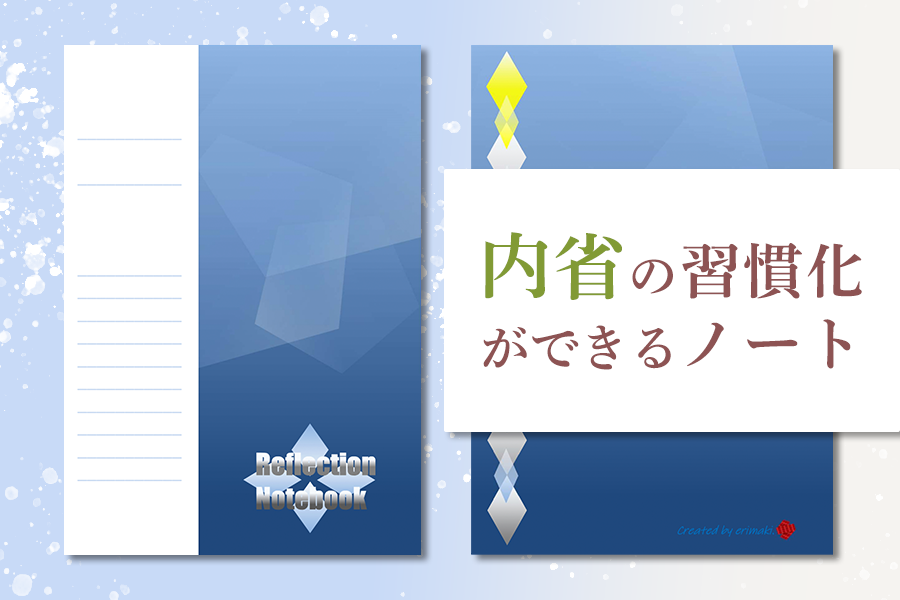
計画と振り返りで内省の習慣化ができるリフレクションノート販売中!
While working on this, I encountered a tool called "Reflection Cards." In a world where there wasn't much guidance on how to do reflection, this tool seemed practical and valuable. So I participated in the Reflection Cards facilitator training program to learn how to facilitate reflection.
https://hisa-magazine.net/rcard-r/
After taking this training, I realized there are clearly defined moments when reflection deepens. When asked questions from perspectives I hadn't considered, I physically felt triggers for deep reflection. I often use the expression "reflection hitting the mark" - in deep reflection, it really pierces through your body. And because you clearly realize that this is what you were truly thinking, there's even a sense of pleasure. This experience taught me what deep reflection really means.
Through this experience, I came to believe that the key to facilitating deep reflection is how well you can ask quality questions of yourself. Later, I had the opportunity to speak with Hisaki Nakajima, the developer of Reflection Cards, and during our conversation about "how to create questions," he introduced me to Tomonori Izawa's question-making seminar. Izawa's seminar was also very educational, and my understanding of how to create questions became clearer. The seminar covered the ORID framework and Izawa's approach to question-making. I already knew about the ORID framework before attending, but combining it with the perspective of question-making made it more real. I was also greatly influenced by the perspective of constructing questions with awareness of axes.
https://note.com/izawa_qft/n/nfb4b3f797b90?magazine_key=m47bec6a972db
After attending this question-making seminar, I was looking at slides about the ORID framework and creating questions with awareness of axes. I wondered what would happen if I mapped the ORID framework to question-making axes. I tried mapping with time on the horizontal axis and individual, colleagues, organization, and society on the vertical axis. The result? It didn't fit well. The shape was distorted.
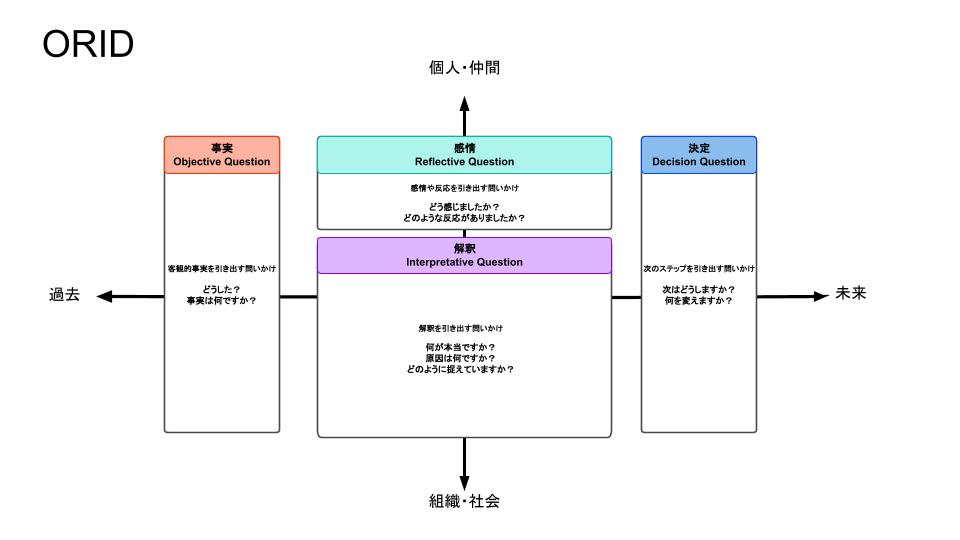
Facts, feelings, and decisions in ORID seemed to fit well, but interpretation didn't. As I wondered what this meant, I noticed something. I realized that ORID's interpretation framework combines two things. One is literally the interpretation element, and the other is the meaning-making element. When I split the interpretation framework into two and mapped it, it fit perfectly. It felt like solving a puzzle. I discovered that ORID could actually be divided into ORIMD, and when I tried asking myself questions using this framework, it felt natural. It was similar to the deep reflection sensation I felt during the Reflection Cards training - I realized that effective reflection means carefully following your thought process and articulating it.
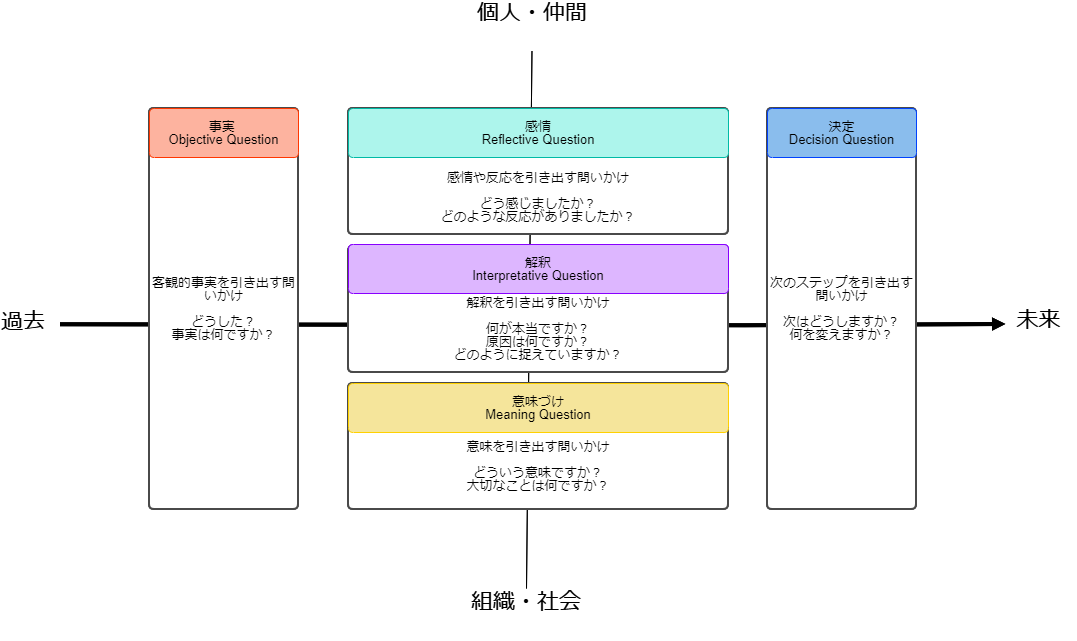
I developed this further. I realized that discoveries through self-dialogue in reflection come not only from learning from the past but also from learning from the future. I wanted to express this better. I had recognized that learning from the past relates to the "experiential learning model" and learning from the future relates to "Theory U." For learning from the past, you can deepen reflection by asking questions in order: facts, feelings, interpretation, meaning, decision. For deepening learning from the future, I discovered that asking questions in the order of decision, feelings, interpretation, meaning, facts leads to insights. When I connected the flow of learning from the past with the flow of learning from the future with arrows, an ∞ shape appeared.
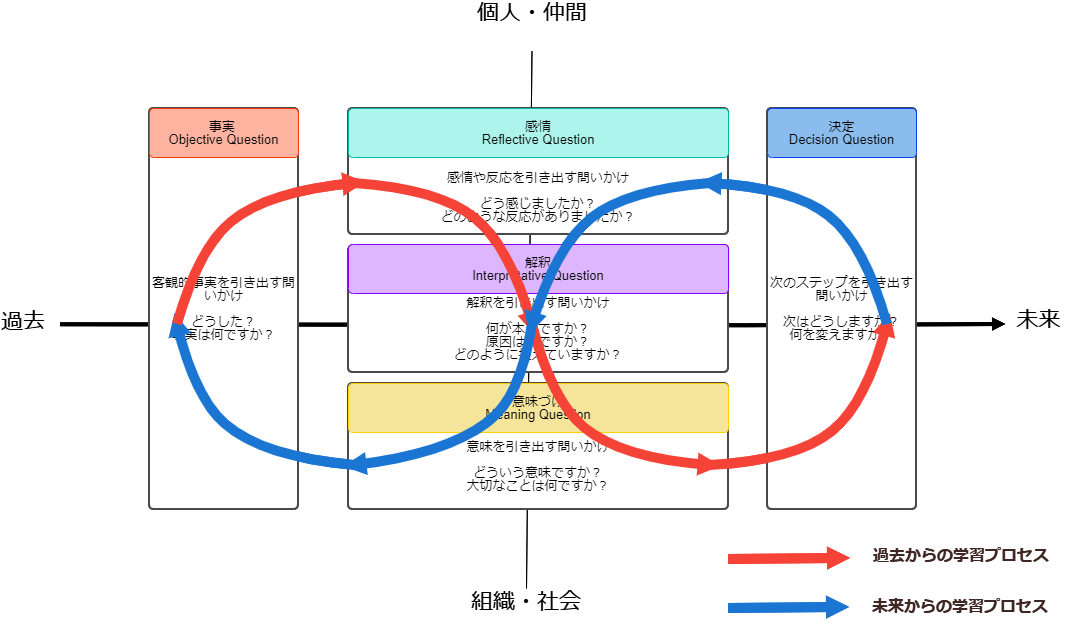
This was another shocking moment for me. I discovered that by cycling through the flow of learning from the past and the flow of learning from the future, you can deepen reflection. I was amazed. Until then, there had been almost no frameworks for achieving deep reflection, so I realized that anyone could deepen their reflection to a certain level using this.
This was the moment I became certain that this was my life's work. Since I myself hadn't understood how to do reflection effectively, I thought that if I could share this mechanism with the world and make reflection a normal practice for everyone, the world would be a happier place. This led me to start sharing information about reflection on this blog, commercialize the Reflection Notebook, hold workshops, and develop apps. I am working to eliminate the "reflection capability gap" that exists in the world, creating a society where everyone can live happily.
The web service that embodies these thoughts is "RefCla."
https://reflectioncloud.achireth.onl/
Summary
What did you think? Here's a summary:
- Through taking leave, I realized the importance of facing myself.
- I started learning about reflection but became aware that there were almost no methods for effective reflection.
- Through my own research to create a reflection framework, I discovered a framework.
- I am now working to eliminate the "reflection capability gap" using this reflection framework.
That's all. Thank you very much for reading this long article to the end.
Recommended Books
Here are the books that influenced my discovery of the framework:
RefCla
For those who want to clarify worries, anxieties, and vague concerns about the future. RefCla is a tool that supports people who want to transform worries and anxieties into "positive action." It supports effective reflection in a natural way.
https://reflectioncloud.achireth.onl/
TIELEC aims to create a self-actualization society through improving reflection capabilities across society.
https://www.tielec.net/
Was this article helpful?

If this article helped you organize your thoughts
a coffee-sized support would be much appreciated.
※ This is separate from tipping, but—
If you'd like to organize similar themes in your own context, I also offer dialogue sessions as a form of thought organization.
Recommended for you