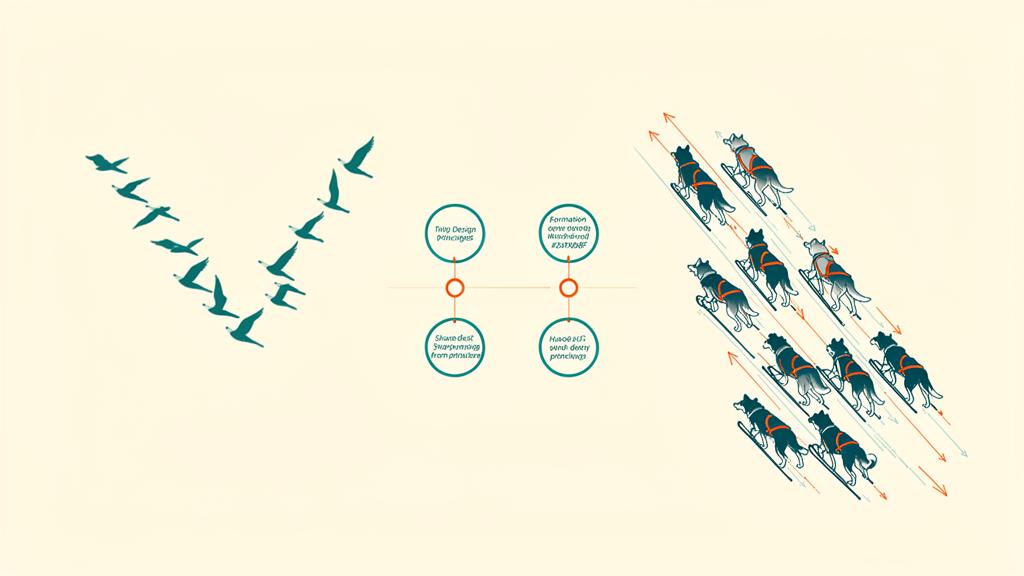
Formation Design Lessons from Birds and Sled Dogs
In the previous article, digging into "why organizations burn out," one thing became clear.
The problem isn't "how to run" but "what formation to run in."
This time, I want to take a closer, more careful look at two formations from nature -- migratory birds and sled dogs -- and extract the design principles embedded within them.
A Closer Look at the V-Formation
I touched on the V-formation in the introductory article, but let me lay it out more systematically. This formation has three design principles built into it.
First: uneven cost distribution.
The lead bird takes the full force of wind resistance. Trailing birds ride the updraft created by the leader and fly with roughly 23% less energy. In other words, cost differs clearly by position. And the entire flock shares this understanding.
In our organizations, this "cost difference by position" often becomes invisible. What a manager carries on their shoulders -- team members only see the results, not the process of exhaustion.
Second: natural rotation.
When the lead bird tires, it quietly drops to the back. The next bird moves forward. What's crucial here is that this rotation requires no "decision meetings" or "performance reviews." Energy levels serve as the trigger, and the swap happens naturally.
The reason this is hard in human organizations is that too many things block rotation: power, pride, the framing of "demotion." Migratory birds have none of that. Dropping to the back carries no negative meaning whatsoever.
Third: the meaning of being in the back.
This might be the most important one.
Trailing birds aren't resting. They're receiving the updraft from the bird ahead and storing energy to take the lead next. Being in the back isn't "standby" -- it's "preparation."
This distinction feels enormously important for organizational design. The reason there's no hierarchy between "being in front" and "being in back" is that the rear position has a clear role and meaning of its own.
The Sled Dog Formation
Sled dog teams have a similar structure.
The lead dog judges direction and reads the snow surface first. It bears the greatest decision-making load and energy cost. And this lead dog doesn't stay at the front forever. When signs of fatigue appear, it rotates to the back, and another dog takes the lead.
What's fascinating here is the role of the musher.
The musher's job isn't "making the team run faster" but "knowing when to rotate." Which dog is wearing down? Which dog is ready to move forward? Sensing this and reshuffling the formation.
I think this offers a hint for rethinking the role of management in organizations.
A manager's job might not be "running at the front yourself" or "making the team run faster," but rather "knowing who should lead when, and who should step back when."
Design Principles Shared by Both Formations
Migratory birds and sled dogs look different on the surface, but extracting their shared design principles reveals this:
1. Cost visibility
Being at the front has a cost. And that cost is visible to the entire group.
2. Systematized rotation
Rotation isn't "failure" or "demotion" -- it's a pre-built feature of the design.
3. Meaningful rear positions
Being in the back isn't "slacking" -- it's "preparing to take the front next."
4. Whole-system optimization
Managing individual exhaustion ultimately maximizes the group's overall speed of progress.
Written out like this, each one seems obvious. But I've rarely seen an organization where all four are present.
How Far Do Existing Theories Go?
Theories that touch on these ideas already exist, at least partially.
Shared Leadership proposes that leadership isn't fixed to one person but rotates based on context. It's close to the feeling of sled dogs swapping the lead position.
Energy Management theory (Loehr & Schwartz) advocates "managing energy, not time" and intentionally designing cycles of expenditure and recovery. The V-formation is essentially the collective version of this.
And Regenerative Leadership (Hutchins & Storm) holds that "organizations, like all living systems, have rhythms of expansion and contraction, creative sprints and depths of recovery," bringing nature's rhythms into organizational thinking.
However, honestly, all of these are articulated as "philosophies," but when it comes to concrete system-level design, they still fall short.
They say "you should rotate." But the practical questions -- "What role title does someone transition into?" "What happens to compensation?" "What triggers the rotation?" -- remain unanswered.
What This Series Aims to Explore
That's exactly why I want to push further in this series.
What does it take to apply the design principles extracted from migratory birds and sled dogs to human organizations? Specifically, I want to face questions like: "When someone moves from the front to the back, what name and role do we give them?" and "How do we design compensation?"
Next time, I'll write about one hypothesis: a role called the "Senior Supporter."
It's still a rough idea, honestly. But I think there's value in putting rough ideas out there.
Previous article:
なぜ組織は疲弊するのか
Next article:
シニアサポーターという役割設計 ―「降格」を「移行」に変える
Was this article helpful?

If this article helped you organize your thoughts
a coffee-sized support would be much appreciated.
※ This is separate from tipping, but—
If you'd like to organize similar themes in your own context, I also offer dialogue sessions as a form of thought organization.
Recommended for you