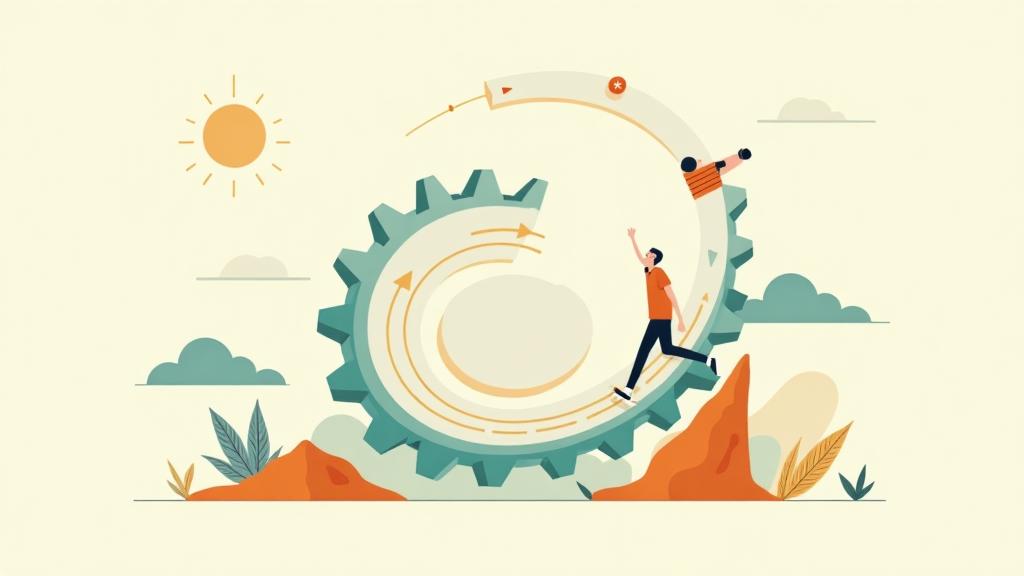
The Productivity Trap, and Choosing to Stop
I don't think this will come together neatly, but I want to record what I've been thinking.
Last time, I wrote about how AI training is essentially "procurement". After that article, my thinking kept rolling and landed somewhere completely different. This is a record of that journey.
What Am I Using This Time For?
Sometimes, in the middle of work, a thought strikes me.
Right now, I'm sitting at a computer, typing on a keyboard. That's it. If you isolate this moment, it's just data entry.
Of course, I can assign meaning to it. I work, earn money, go traveling. I grow through work. I find purpose. If I tell myself these stories, I can convince myself it makes sense.
But sometimes, "What am I using this time for?" just won't go away.
Previously, I wrote about the paradox of running to rest, where I mentioned the Pirahã people. They're hunter-gatherers in the Amazon who speak a language with no past or future tense. Three to five hours of hunting or gathering per day, and the rest is rest, conversation, and laughter. The concept of "sacrificing now for the future" simply doesn't exist.
In that article, I wrote about the structural contradiction where increased productivity doesn't lead to more leisure. Keynes's prediction, the Red Queen effect, the idea that it's a structural problem rather than a personal one.
This time, it's more personal. It's about realizing that I myself am running within that very structure.
AI Is Removing Every Reason to Stop
Lately, I've been able to develop semi-automatically using AI. Brainstorming, writing articles, building tools. Things that used to take hours now move at astonishing speed.
This is a good thing, I believe.
But it also scares me a little.
In the old days, I used to stop naturally. Writing code took time. Writing articles required mental energy. Structuring ideas demanded brainpower. So at some point, "that's enough for today" would happen on its own.
Now it's different. If I want to, I can keep the wheels spinning indefinitely.
When you're caught up in productivity, you can't stop the work. You keep going because you can. You ship because you can. You build because you can.
This is what I call "the productivity trap."
What I wrote in the previous article came right back at me. "Maybe all that efficiency gains do is bring more tasks raining down" — that was about structure. But it turns out the one raining tasks down on me was myself. Because I'm doing what I want to do, there's no need to stop. Because there's no need to stop, I can't stop.
It's Not That I'm Afraid to Stop
So am I afraid of stopping? Not really.
If I stopped all productive activity today, would my worth change? Not at all. I might miss a work deadline, but honestly, that's about it. If my work pauses for a day, the impact on the world is essentially zero.
If asked what I'd do if I stopped, I'd probably go to a sauna, or take a walk around a nearby shopping mall. Something like that.
In other words, there's no fear of stopping. Stopping wouldn't lead to nihilism.
But there's this feeling that I'm not choosing when to stop.
I'm doing what I want to do. Nobody's forcing me. Yet it feels less like "I decided to stop" and more like "I'm just flowing along." My hand is on the accelerator, but I'm not consciously pressing the brake.
I think of the Pirahã again. Maybe they don't distinguish between "stopping" and "running." Hunting, resting, talking, laughing — it all flows as one undivided stream. There's no need to switch and say, "That's enough for today."
But in my world, "working" and "resting" are clearly separated. That's why the question "Am I choosing when to stop?" arises, and why it creates this subtle discomfort.
The Balance Between Convergence and Divergence
Time spent working is essentially in "convergent thinking" mode. Problem-solving, structural design, implementation. Narrowing down toward a goal. AI accelerates this convergence further.
The concepts of "convergent thinking" and "divergent thinking" were proposed by American psychologist J.P. Guilford in 1956 (reference: Divergent thinking - Wikipedia). Guilford distinguished between "thinking that converges toward a single correct answer" and "thinking that spreads out toward multiple possibilities." Creativity, he argued, requires the latter — divergent thinking.
When I think about taking a break at a sauna or walking aimlessly, this distinction clicks. Your body is relaxed, there's no need to produce results, and you don't have to decide anything. In that state, when you let your mind wander, ideas sometimes emerge unexpectedly. You're not thinking deliberately — it feels like your brain is organizing and connecting information on its own.
Perhaps what I really wanted wasn't "time to rest" but time in this divergent mode.
Convergence alone is suffocating. Divergence alone produces nothing tangible. Both are necessary. But as AI has accelerated convergence, the time for divergence has relatively shrunk. That's where the discomfort was coming from, I think.
What's fascinating about Guilford's framework is that he identified four characteristics of divergent thinking: fluency, flexibility, originality, and elaboration. None of these emerge when you're rushing. They're powers that only work when there's margin.
Designing the Act of Stopping
Maybe it's important to sometimes deliberately stop all activity. That's what I've come to think.
It's not laziness — it's an act of reclaiming agency. Choosing for yourself: "I could keep going, but I choose not to." Knowing you can stop gives freedom back to the accelerator too.
In the previous article, I wrote about the "Red Queen effect." The structure where you must keep running at full speed just to stay in place. That was about society as a whole, but I feel the same dynamic operating within individuals.
What happens if you stop?
I think you'd probably come full circle and want to start again.
If that's the case, then you're not enslaved by productivity — there's genuine energy within you. You're not being spun; you're spinning on your own.
I Can't Become Pirahã, But
In the previous article, I wrote about how linguist Daniel Everett lived among the Pirahã for 20 years but eventually brought in a generator-powered freezer and a DVD collection. "I was tired of the rough living," he said.
What's interesting about this story is how honest it is.
I understand the value of "living in the present" intellectually. I can see the beauty of the Pirahã way of life, where "this moment is complete in itself." But having grown up in a culture that sees life as a line from past to future, I can't fully adopt that way of being.
And that's probably fine.
I can't become Pirahã completely, but I can consciously reclaim divergent mode within myself. I can build "stopping" into my design.
If the previous article looked at "the paradox of running to rest" as a structural problem, this time I've come down to something more personal. Even if I can't change the structure, maybe I can change the rhythm within myself.
Still Not Fully Sorted Out
I'm not sure myself how I got from AI training data to here. I was supposed to be talking about technology, but the question shifted to "What is this time for?", I recalled the Pirahã, thought about the productivity trap, pulled out Guilford's theory, and started thinking about saunas.
But maybe this kind of rolling thought process is itself divergent mode.
I don't have an answer. But I do think I want to design "choosing to stop" a bit more deliberately.
Are you choosing when to stop?
Was this article helpful?

If this article helped you organize your thoughts
a coffee-sized support would be much appreciated.
※ This is separate from tipping, but—
If you'd like to organize similar themes in your own context, I also offer dialogue sessions as a form of thought organization.
Recommended for you