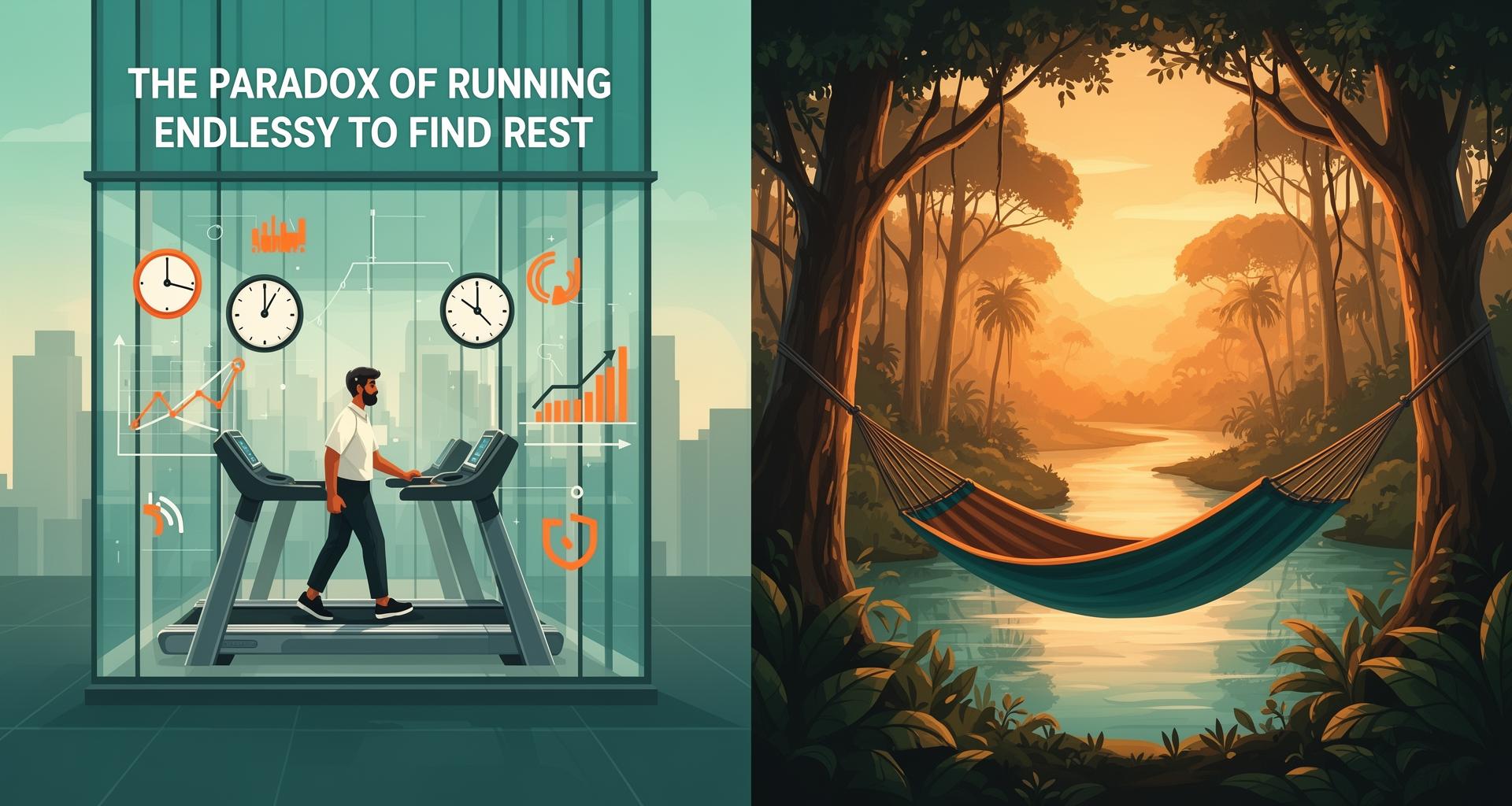
On the Paradox of Running Endlessly to Find Rest
AI is dramatically improving work productivity. Code is generated instantly, reports are summarized automatically, and designs are completed in seconds. The wave of efficiency is indeed coming.
Yet there's no sense that leisure awaits on the other side. Instead, there's an unspoken pressure to produce even more output with the time we've freed up. If productivity increases, we should be able to relax more—so why do we keep running?
This might sound like a problem unique to AI. But actually, this story has been going on for a very long time.
A Promise Repeated Over and Over
Economist Keynes predicted in 1930 that by around 2030, technological progress would reduce our work week to 15 hours. Washing machines promised "freedom from housework," computers heralded a "paperless society," and the internet showed us "the freedom to work from anywhere."
Each promised to save time. Yet leisure never increased.
Instead, emails demanded 24/7 responses, remote work blurred the boundaries between work and life, and social media turned even our rest time into a vortex of information. We're supposed to be more convenient, but we're busier than ever.
Honestly, I think AI will follow the same path. The time we save through efficiency will just be filled with more tasks, I suspect.
An Alternative Way of Life Actually Exists
Here's a contrasting example.
The Pirahã people of the Brazilian Amazon spend about 3-5 hours a day hunting and gathering, then devote the rest of their time to rest, conversation, and laughter. They have no words for counting, no habit of worrying about the future, and no attachment to accumulation.
Linguist Daniel Everett lived with them for 30 years and testified: "The Pirahã are the happiest people I have ever seen. They laugh and enjoy themselves all day long, and they cannot even understand the concept of depression or suicide."
In other words, a life of "working only when you want to" is not impossible for humans. Right now, somewhere on this planet, people are living exactly that way.
The problem is, it's not as simple as "then why don't we just do the same?"
Knowing, Yet Unable to Do
There's more to Everett's story.
He lived with the Pirahã for 20 years and was deeply influenced by their attitude of "living in the present." He says he learned the value of "not worrying about the future" and "doing your best each day." The influence was so profound that he abandoned his Christian faith.
Yet ultimately, he brought a generator-powered freezer and a DVD collection into the village. "After 20 years of living like the Pirahã, I was tired of the crude life," he admitted.
I think that's remarkably honest.
Intellectually, we can understand. The value of "living in the present," the richness of a life that doesn't seek "more." But actually living that way is another matter entirely. Even after 20 years, Everett couldn't fully become like the Pirahã.
We've been raised in a culture that sees life as a "line." A line from past to future. On that line, we're constantly asked "how far have you come?" and "where are you headed?" We cannot fully exist in the "here and now."
The Pirahã probably don't have this "line." Wake up, go to the river, catch fish, eat, talk, laugh, sleep. Each moment is complete in itself. It's not "on the way." That's why, I think, the impulse to seek "more" never arises.
Not an Individual Problem, But a Structural One
Another important point is that Everett had somewhere to return to. He had a university position and a publishing contract. So he could bring his experience back as "learning."
But most of us don't have a safe landing spot if we step off the treadmill.
Capitalism is premised on growth. Productivity improvements are used not for "the same results with less effort" but for "more results with the same effort." As long as competition exists between companies, any company that uses efficiency gains for rest will lose to competitors who channel them into more production.
This is a collective dilemma. If everyone said "enough" all at once, things might change. But if only one person does, they're at a disadvantage. The Red Queen effect—having to run at full speed just to stay in the same place.
So this problem isn't about individual willpower. It's structural.
And Yet, I Don't Want to Give Up
I honestly can't expect something that hasn't changed throughout all of history to change in my lifetime. Even if AI dramatically increases productivity, that surplus will probably just be used for "more growth." Wealth won't be distributed equally, and inequality will keep growing. We'll end up unable to escape the world of winners and losers—part of me thinks that.
But I don't want to give up.
As an engineer, I believe the direction of technology itself isn't wrong. We should be able to reach a point where AI calculates and produces everything humans need to live. The problem is the human choice of how to use that technology. And that choice hasn't been made yet.
Looking at the Pirahã way of life, I can see a little of what we've lost. Because they don't accumulate, they don't exhaust the land. Because they don't compete, they don't fight over resources. Because they don't worry about the future, they don't seek "more, more" endlessly.
Meanwhile, our civilization keeps putting enormous strain on the planet while pursuing "growth." More, faster, more efficient. But is there really "happiness" at the end of that path?
What way of being is truly needed of humans as creatures living on this planet called Earth? I believe holding that question is the first step toward something new.
There Is Another Way
A race that started "to find ease" has somehow become about racing for its own sake. We haven't yet found a way out of that loop.
But what the Pirahã teach us is that "another choice exists." Not accumulating, not competing, not worrying about the future—with that way of life, they live happily. The premises we take for "granted" aren't actually absolute.
If AI truly increases productivity dramatically, then in theory, we should be able to supply what humans need to live with less labor. Food, housing, medicine. Whether we use that surplus for "more growth" or "more leisure"—that choice should still be open.
It won't change quickly. The structure is strong. But if more people start asking about "what humans should be for the planet," perhaps we'll begin to see a path other than "more, more."
I believe in that possibility, and I keep moving forward without giving up.
Was this article helpful?

If this article helped you organize your thoughts
a coffee-sized support would be much appreciated.
※ This is separate from tipping, but—
If you'd like to organize similar themes in your own context, I also offer dialogue sessions as a form of thought organization.
Recommended for you