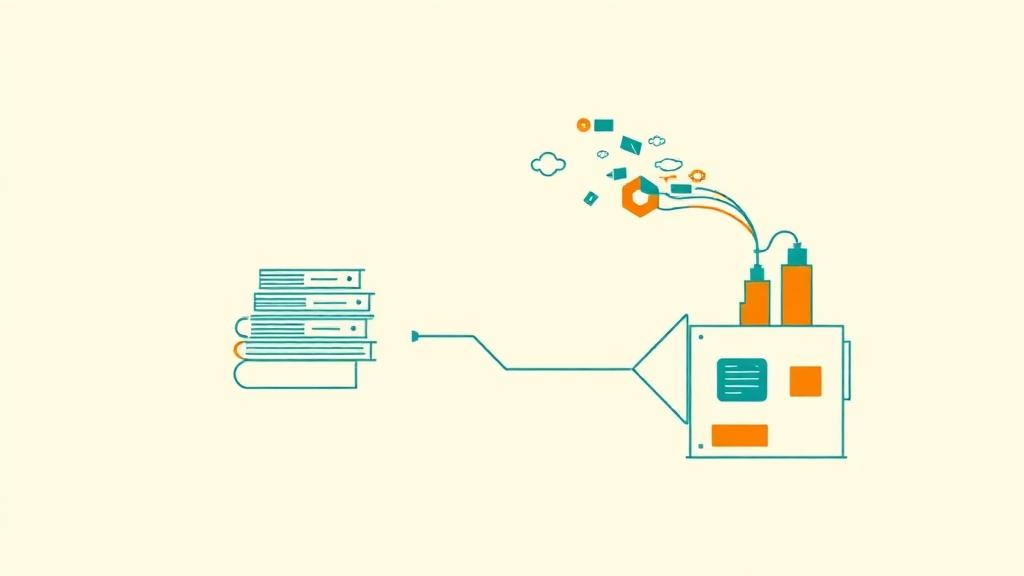
AI Training Data Is Procurement — A Statement of the Obvious
One evening, I was chatting casually with an AI when my thinking rolled off in an unexpected direction.
It started with something trivial — I was just comparing AI model capabilities. I asked about the latest model's features, which led to a discussion about Grounding (the mechanism that connects generated content to external information sources), and from there the question emerged: "What exactly is a model's memory?"
A model's memory. That is, the statistical patterns from massive amounts of text that an AI compresses into weights during training. Not a database, not logs, not cache — just weights.
Up to this point, it's a technical discussion.
But then it hit me: "That 'massive amount of text' — who created it, and how?"
Training Data Is Someone's Work Product
Newspaper articles are written by reporters who do actual reporting. Magazine features are planned by editors, researched and structured by writers, then published. Books are written by authors over months or years.
Naturally, this costs money. And to recoup those costs, content is put behind paywalls or sold as books.
AI companies use all of this as training data.
This is structurally identical to "procurement" in business.
When an IT company hires engineers, it shows up as labor costs on the P&L, but it's essentially "procuring human intellect to build products." Procurement isn't limited to tangible goods.
For AI companies, training data is the raw material for creating products. The fact that this should come with a price tag is perfectly natural in a market economy.
The IQ 200 Research Lab
I found a metaphor that clicked for me.
AI training is like a research lab staffed with people who have an IQ of 200.
They buy and read massive quantities of books for their research. Being brilliant, knowledge accumulates in their minds at extraordinary density. And from that, they create new value.
But the only price they pay is the cost of the books.
What's wrong with that?
Honestly, I don't think there's anything inherently wrong with this picture. Human researchers reading vast amounts of books and creating new theories or products from that knowledge is completely legal and healthy.
However, the scale is orders of magnitude larger with AI. It can process in an instant what no human could read in a lifetime. And as a result, it potentially creates a situation where people no longer need to read the original content.
That's where the real issue lies.
So How Many Subscriptions Should They Pay For?
I tried thinking about it simply.
How many average humans' worth of processing power does an AI model have? Pay that many subscriptions to paywalled media. Buy that many copies of each book.
Of course, AI processing isn't the same as human "reading," and a simple headcount conversion might not work in practice. But in essence, that's the idea.
Procurement has costs. If you're running a business, there's no justification for not paying them.
I'm not saying every piece of information on the web should come with a price. I don't think people should pay to read personal blogs. But for media that is clearly produced at significant cost and has a subscription-based revenue model, ignoring that structure isn't fair.
"If Both Sides Agree, It's Fair"
As I kept thinking, I found my landing point.
AI companies and content providers reach agreement through licensing deals or revenue-sharing arrangements. Both sides are satisfied. Compensation is paid.
Then it's fair, isn't it?
No coercion. Information is disclosed. There's agreement. There's compensation. These are the fundamental principles of a market economy.
In fact, licensing agreements between AI companies and major media outlets are increasingly common. The market is recalibrating.
However, not every data provider has equal bargaining power. Major publishers can sit at the negotiation table, but small independent creators might never even get the opportunity. The question remains whether the premise of "both sides agreeing" truly holds.
But that might not be a problem unique to AI — it may be a structural issue of the digital economy as a whole.
I'm Not Trying to Denounce Technology
Let me be clear: I'm not anti-AI.
The fact is, I benefit from it. In daily work, in bouncing ideas around — having AI as a partner has taken me to places I couldn't have reached alone.
That's precisely why I want this system to be healthy.
Enjoying the benefits of technology while questioning whether the structures supporting it are fair. Looking at both sides instead of leaning one way. That's the least I can do as someone who uses it.
There's No Answer Yet
The legal framework around AI training data hasn't been settled globally. Multiple lawsuits claiming copyright infringement are ongoing, and the boundaries of fair use remain in flux.
"It feels unsettling, but there's no answer yet" — that's the honest state of things, I think.
But we can think about it.
I want to frame this issue not as a question of whether technology is good or evil, but as one of economic circulation. Procurement comes with costs. If there's agreement, it's fair. That's all there is to it.
How do you feel about AI training data?
What follows is a record of how my thinking continued to roll further that day. From AI market fairness to the void at the end of rationality, enlightenment, and something like love. Honestly, I wasn't sure whether to write this. But as a sandbox for thought, the flow itself felt meaningful, so I decided to keep it. If you're interested in "the sensation of technology connecting straight through to philosophy of life," read on.
The rest is exclusive content for supporters
Deeper insights on reflection and decision-making processes
Support the author to continue reading

Was this article helpful?

If this article helped you organize your thoughts
a coffee-sized support would be much appreciated.
※ This is separate from tipping, but—
If you'd like to organize similar themes in your own context, I also offer dialogue sessions as a form of thought organization.
Recommended for you