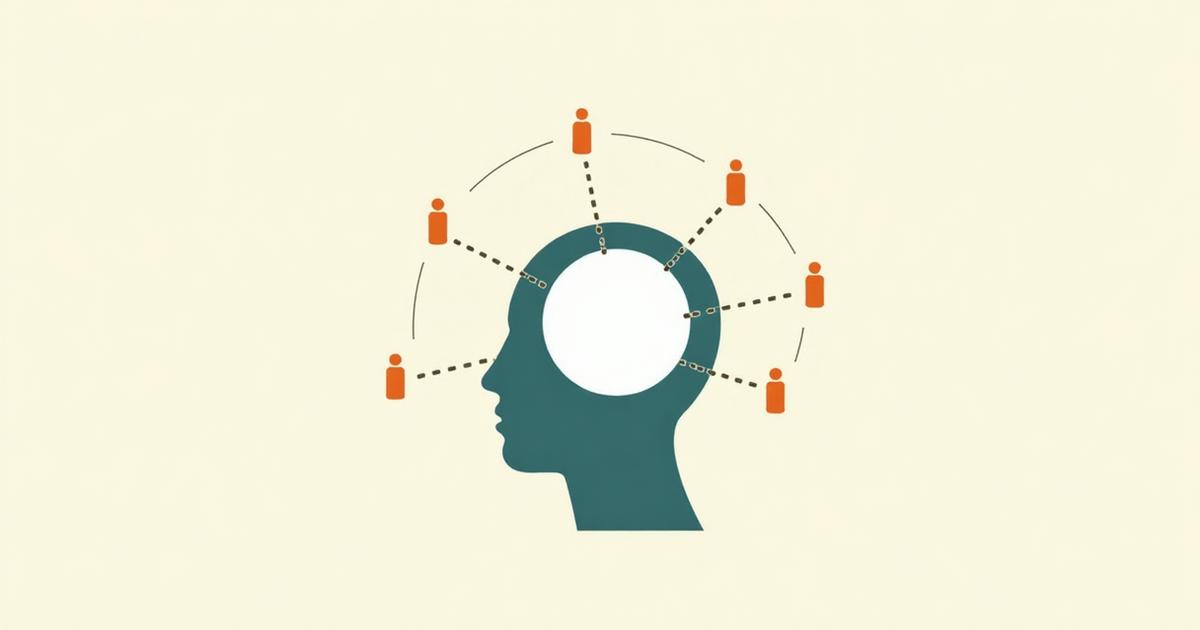
What Comes Before \"Be Interested in People\" — On Cognitive Margin in Organizations
Today, while facilitating a dialogue-based workshop, something kept nagging at the back of my mind.
It was about the phrase: "Being interested in people is important."
This may turn out to be a somewhat disorganized piece of writing, but I wanted to capture these thoughts while they're still fresh.
Correct as a Statement, Yet Something Is Missing
In the context of management and team building, "being interested in people is important" is a phrase you hear often.
I think it's fundamentally true. I have no objections to it.
But what I felt today, while actively facilitating the space, was that this statement comes with a prerequisite — one that's often left unstated.
Whether you can be interested in people depends on whether you have the mental margin to do so.
And if you can't find that margin, isn't that less of an individual problem and more of an environmental or structural one?
In Defense Mode, People Can't Be Interested in Others
What happens when people lack mental margin?
Chased by deadlines, pressured by evaluations, bombarded with unreasonable demands from above — in that state, the brain enters "defense mode."
In defense mode, curiosity about others diminishes. Empathy declines. The field of vision narrows to short-term results. People start seeing others not as "someone to understand" but as "a risk factor."
In other words, "being interested in people" is a higher-order function that only works when cognitive resources are in surplus.
This aligns with Maslow's hierarchy of needs. Genuine interest in others doesn't easily activate when your own sense of safety hasn't been met.
Telling People to "Show Compassion" Inside a Burning Building
The problem is that this is exactly what's happening in many organizations.
They're inside a burning building, telling managers to "show more interest in your team."
Chronic understaffing, excessive performance pressure, a culture of zero tolerance for mistakes, relative evaluation systems — telling people within these structures to "be interested in people" amounts to little more than a motivational platitude.
Because the structure itself makes indifference the rational choice.
Drawing out honest feelings creates more hassle. Knowing people deeply brings responsibility. So staying indifferent is safer — if that's the structure, there are limits to changing individual awareness.
Organizations Where People Can Be Interested in Others Are Organizations with Margin
Looking back at today's workshop, the participants were relatively attentive to each other's stories.
Why was that?
Probably because there was a certain kind of margin built into this space. Time without evaluation. Time where you don't need to rush to the right answer. Time where you're simply allowed to think.
An organization where people can be interested in others is probably one where this kind of margin is designed into everyday operations. Being interested isn't the "result" — having margin is the "cause."
So Where Does the Responsibility Lie?
This is something I want to think about more carefully.
Ultimately, it's executives who create the structure. So the responsibility for leaving an organization where "people can't be interested in others" falls on the leadership layer.
However, executives themselves exist within structures too. Shareholder pressure, market competition, demands for short-term profit — they're often pulled by external forces. So you can't simply say "it's management's fault."
But if there's one thing that can be said: whether you have the awareness that a margin-less organization is a problem — that is an executive's choice.
The Question of What Sustainable Management Really Means
As I followed this line of thinking, a question emerged.
Could sustainable management mean continuously designing "cognitive margin" into an organization?
When people talk about sustainable management, they usually mention ESG, long-term profit, and talent retention. But when you decompose those concepts, they share a common thread: "a state that isn't at the mercy of short-term optimization."
And perhaps cognitive margin is what's needed to create that state.
Organizations without margin enter defense mode. In defense mode, learning stops. When learning stops, results plateau. Top talent leaves.
This is a matter of time horizons. Cutting margin looks efficient in the short term, but in the long term, it destroys the organization's capacity for self-renewal.
What I Haven't Fully Worked Out Yet
That said, today's reflections are still rough.
For example, I haven't at all worked through how to systematize "margin" as an institutional practice. Should you cap utilization rates? Make reflection time a sanctioned work activity? Redesign the evaluation system? — I want to think through the specifics on another occasion.
If there's one question I want to leave from today, it's this:
Is margin something created by willpower, or something created by structure?
My fundamental belief is that people are governed more by environment and structure than by will. If that's the case, the answer is the latter. But what does it mean in practice to "create margin through structure" — that question, I still can't quite put into words.
For now, I'll leave here the discomfort I felt while facilitating today's dialogue workshop.
Recommended Reading
For those who want to explore the relationship between "learning" and "margin" in organizations more deeply, this book offers valuable insights.
And for a perspective on how to design organizational culture, this book is also thought-provoking.
Was this article helpful?

If this article helped you organize your thoughts
a coffee-sized support would be much appreciated.
※ This is separate from tipping, but—
If you'd like to organize similar themes in your own context, I also offer dialogue sessions as a form of thought organization.
Recommended for you