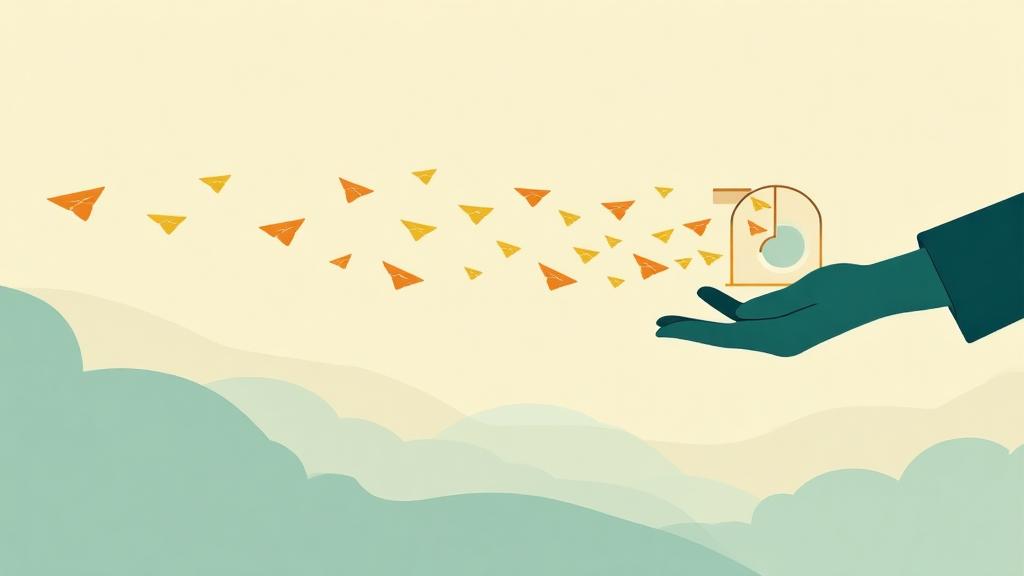
Leaving Words That Arrive Late
I've been thinking a lot lately about the value of art and content in the age of AI. This may turn out to be a disjointed piece, but I want to write it while I'm still in the middle of figuring things out.
When "Being Able to Create" Loses Its Value
With AI's evolution, the cost of creation is approaching zero. Beautiful images, polished prose, convincing music — anyone can produce them now.
When that happens, the mere ability to create loses its value.
So what remains? This question has been nagging at me for a while.
When technical polish no longer sets people apart, the source of value shifts to why someone created something — their intent, their context, the accumulated sediment of their life. At least, that's what I've come to feel.
What "Resonance" Really Is
When I asked myself "What makes content valuable?", the answer that surfaced was simple: something that resonates.
But what does it mean for something to resonate?
Looking back, there was a song I loved in my twenties. I listened to it during hard times, and it gave me the strength to keep going just a little longer. Part of its power was in the music itself, I'm sure. But it wasn't just that — it overlapped with where I was in life at the time.
In other words, resonance doesn't live solely within a work. It's born when the listener can project themselves into it.
Structure × self-projection.
AI can mass-produce "structures that seem like they'd resonate." But connecting with a specific moment in someone's life — that kind of coincidence can't be engineered. That's why I suspect "negative space" matters more than polish. Something slightly imperfect offers an easier way in than something too refined.
Keeping Distance from Competition
This is a bit of a tangent, but thinking about content in the AI era inevitably leads to the topic of competition.
Page views, engagement, follower counts. With metrics made so visible, everyone is automatically thrown into an infinite ranking battle.
I'm not trying to reject competition itself. In sports, for instance, there's a special thrill in competing neck-and-neck with someone just slightly above your level. The tension of having to give everything you've got. The feeling of focus sharpened to a razor's edge. Winning by a slim margin feels incredible, and even losing leaves a sense of having given it your all. It's a feeling of being expanded, somehow.
But lose yourself too deeply in competition, and you lose yourself entirely.
Measuring your worth by comparison with others. Letting external validation define you. Run that way long enough, and your own voice grows faint. "Wait — what am I even doing?" I know this feeling from personal experience.
So rather than rejecting competition outright, what matters is engaging with it at a distance where you don't lose yourself. I think this applies to creating content, too.
The AI era will be awash in content about optimization, success formulas, and efficiency. Content that teaches you how to win. But on the other side — words like "you don't have to rush" and "you don't have to compete" — those will become rare. And rarity quietly generates value.
Reaching One Person in Ten Years
"Would you rather be read by 100,000 people today and forgotten, or remembered by one person ten years from now?"
When I posed this question to myself, I was drawn to the latter.
Spreading versus enduring.
Content designed for instant consumption goes down smooth — you understand it immediately, nod along, and forget it. Content with a delayed fuse, on the other hand, isn't fully understood at first reading. It lingers in the back of your mind and suddenly clicks years later.
The song that resonated with me in my twenties only did so because I happened to encounter it at that particular time. Had I heard it earlier, I probably would have felt nothing.
The timing of resonance isn't something the creator can control.
Accepting that, I still choose to leave words behind. Someone might remember them when the time is right — that's the kind of distance I want to hold.
AI can mass-produce "information that's useful right now." But words that someone remembers five years later can't be manufactured so easily. Their value only emerges when bound to time, context, and the changes in a reader's life.
Leaving the Process of Change as It Is
So what will I do?
I don't think I want to deliver finished thoughts. Rather, there's meaning in leaving the process of change exactly as it is.
Hesitation, wavering, the inability to say things definitively, sensations not yet put into words. From within that, a refined idea occasionally emerges. And that's enough.
AI can produce polished final forms. But the wavering in between — the feeling of "honestly, I got stuck here" — that seems like something that remains as human value.
Wavering generates more resonance than completion.
People respect others' finished ideas, but they're saved by witnessing the trajectory of change. That's how I see it.
If My Past Self Read This
As I write this, a thought occurs to me.
If my twenty-something self read this essay, he'd probably think, "I don't really get what this is about." Back then, I was in the thick of competition, and the idea of stepping away hadn't even crossed my mind.
If I could pass words back to my younger self, I think I'd say:
"Maybe you don't have to try so hard. Maybe you don't have to compete."
Those words probably wouldn't reach him. He wasn't in a state to receive them yet. But I'd leave them anyway.
Because my perspective has shifted since those days. There are things I can see now that I couldn't then. I believe there's meaning in writing those things down.
Even if they don't make sense now, they might connect someday. Like seeds.
What does "content that resonates" look like for you?
Is it about the level of polish? Or did it resonate because it overlapped with something in your own life?
I have a feeling that within your answer lies a hint about what kind of expression will endure in the age of AI.
Related Books
On facing yourself through the act of writing.
On the feeling that "you don't have to rush," seen through the lens of how we spend our time.
What follows is a more personal account. It's about the desire to leave a legacy, the reality of going unread, a personality that craves deep dialogue, and the emptiness of not getting through. It may drift from the main thread, but I wanted to leave these waverings, too. For those who'd like to read quietly.
The rest is exclusive content for supporters
Deeper insights on reflection and decision-making processes
Support the author to continue reading
Was this article helpful?

If this article helped you organize your thoughts
a coffee-sized support would be much appreciated.
※ This is separate from tipping, but—
If you'd like to organize similar themes in your own context, I also offer dialogue sessions as a form of thought organization.
Recommended for you