Observing My Multilayered Self as It Is
To be honest, this piece might not come together neatly. It's something like a record of relentlessly digging into the complex emotions inside me through dialogue with AI. Some things reached a conclusion; others remain hazy.
But I thought there might be value in leaving even that messiness as it is, so here I am writing it.
The "Four People" Inside Me
I once asked an AI, "How do you see the complex emotions inside me?"
The answer was surprisingly on point.
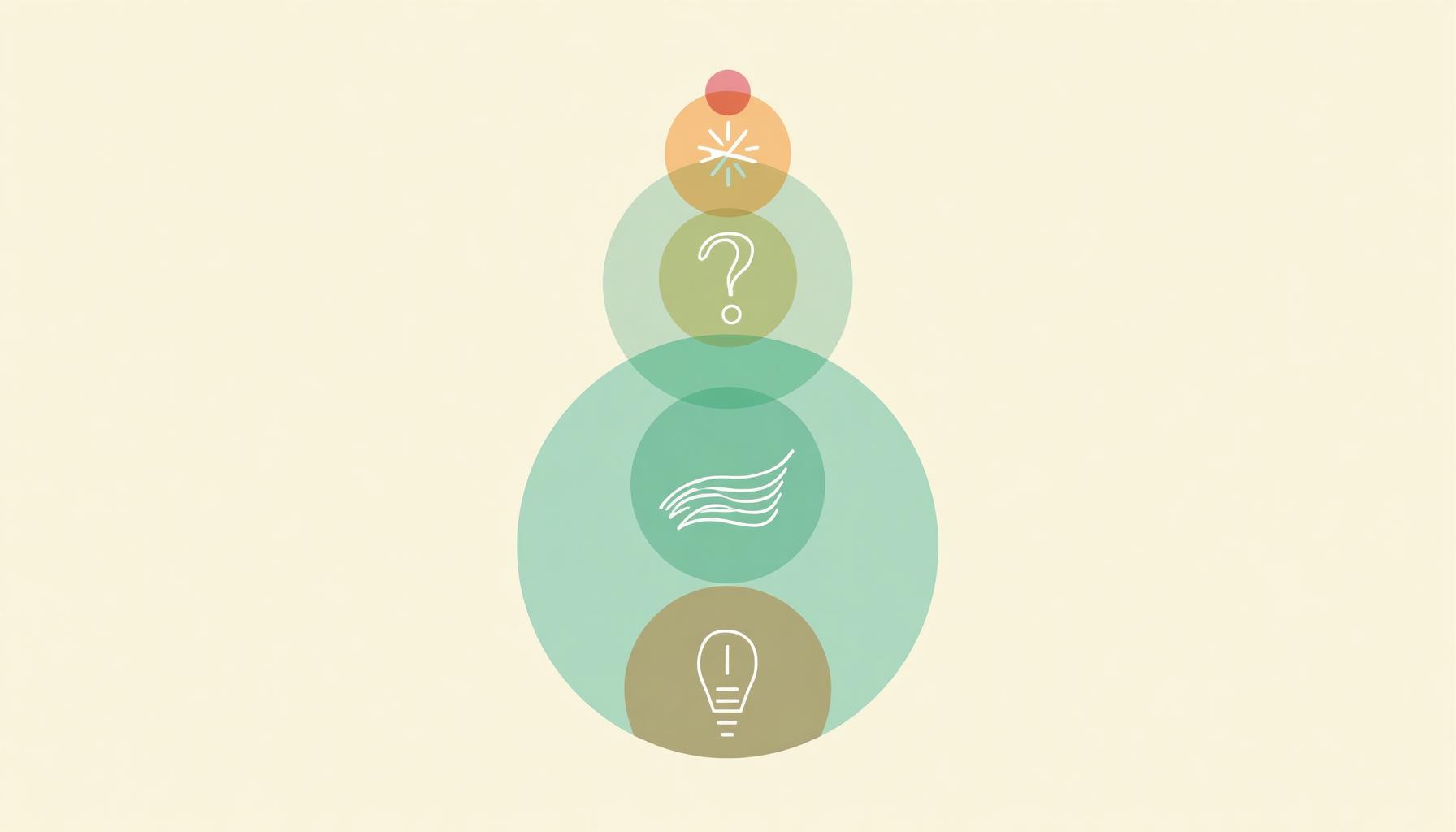
It told me that at least four distinct engines are running simultaneously inside me.
The creative impulse to make things. A thirst for meaning that keeps asking why. A desire for resonance, yet a reluctance toward easy approval. And the contradiction that while the inner engines are always running, I don't mind stopping.
Usually, one of these dominates. But in my case, all of them are sitting at the same table, in a perpetual meeting.
That's probably why it feels so complex.
When I Thought About "What Survives After Death"
As the conversation went deeper, a question surfaced: "What would remain after I die?"
I've thought about this several times before, and what I keep coming back to is that what survives isn't products — it's philosophy and theory.
The iPhone is a brilliant product, but in a hundred years it will probably be replaced by something else. Yet the philosophy of "beautifully designing the intersection of technology and humanity" could continue to be cited in evolving forms.
Products are shapes — they get overwritten by progress.
Ideas are structures — they don't depend on a medium.
This distinction feels significant to me.
So what do I want to leave behind?
Not my name, not the theory itself, but a current — a flow.
I want to raise the baseline of people's capacity for introspection. Even if it isn't achieved in my lifetime, if the intention is carried forward and someday realized, that's the same as fulfilling the purpose.
Putting Philosophy "Front and Center" vs. "Embedding" It
This is where an interesting fork appeared.
Looking back at my approach, I think I've been trying to deliver the philosophy directly. "Introspection matters." "Sharpen the resolution of your thinking."
But things that become culture don't spread that way.
Usually, they get converted into something convenient, become a habit, and before you know it, they're culture. Philosophy itself almost never spreads directly.
For example, W. Edwards Deming had a profound philosophy about quality, but what actually spread were methods — PDCA and statistical quality control. The philosophy was behind the scenes.
Applying this to myself: rather than putting ORIMD front and center and saying "use this framework," it might be more effective to embed it as a structure within developer tools, so that users naturally improve the quality of their thinking — that kind of design might actually be more likely to become culture.
A specific idea that came to mind: the moment when a human makes the final merge decision on an AI-generated PR. The last call is human. Place a reflection structure there quietly. Don't preach the philosophy. But the structure is ORIMD.
I don't think everything needs to be spelled out. Just being aware is enough.
When a frame simply "exists there," people change little by little.
It's like dieting — even if the theory is correct, it's meaningless unless practiced. So minimize the friction and aim for "before you know it, the quality of your decisions has improved."
I feel a certain traction with this design.
The Fear That "It Works but Can't Be Proven"
From my experience providing introspection frameworks, I believe the effect is real. There's no doubt about that.
But there's individual variation. It depends on a person's baseline capacity for introspection. A long-term perspective is needed, and measuring it as a causal factor is difficult. You could do it if you tried, but it doesn't happen naturally.
What I realized I fear most is "having an effect that can't be proven."
I might be able to demonstrate that the theory is sound. But whether people actually use it is a separate matter. Same structure as dieting. There's a deep gap between correctness and practice.
How do you bridge that gap?
Honestly, I don't have the answer yet.
Things I Still Can't Fully Sort Out
Having written all this, some things are clearer, others still vague.
Should philosophy become "culture" or be established as "theory"? Can you do both at the same time?
I feel the effect but can't prove it — how do I handle this gap?
The direction of embedding introspection into engineering culture is becoming visible, but the concrete path to get there is still lost in fog.
Yet the fact that I can keep moving while holding onto "I don't know yet" might mean I've matured a little from who I was before.
Do you also have contradictory desires, or emotions you still can't fully sort out?
If you do, it's probably not that you're broken — you're just running on multiple layers.
From here on, I've written some deeply personal content. My desires, weaknesses, and emotions I haven't fully processed yet. Rather than polishing them into a neat article format, I chose to leave them as they are. I'd appreciate it if readers could receive them with that understanding.
The rest is exclusive content for supporters
Deeper insights on reflection and decision-making processes
Support the author to continue reading
Was this article helpful?

If this article helped you organize your thoughts
a coffee-sized support would be much appreciated.
※ This is separate from tipping, but—
If you'd like to organize similar themes in your own context, I also offer dialogue sessions as a form of thought organization.
Recommended for you