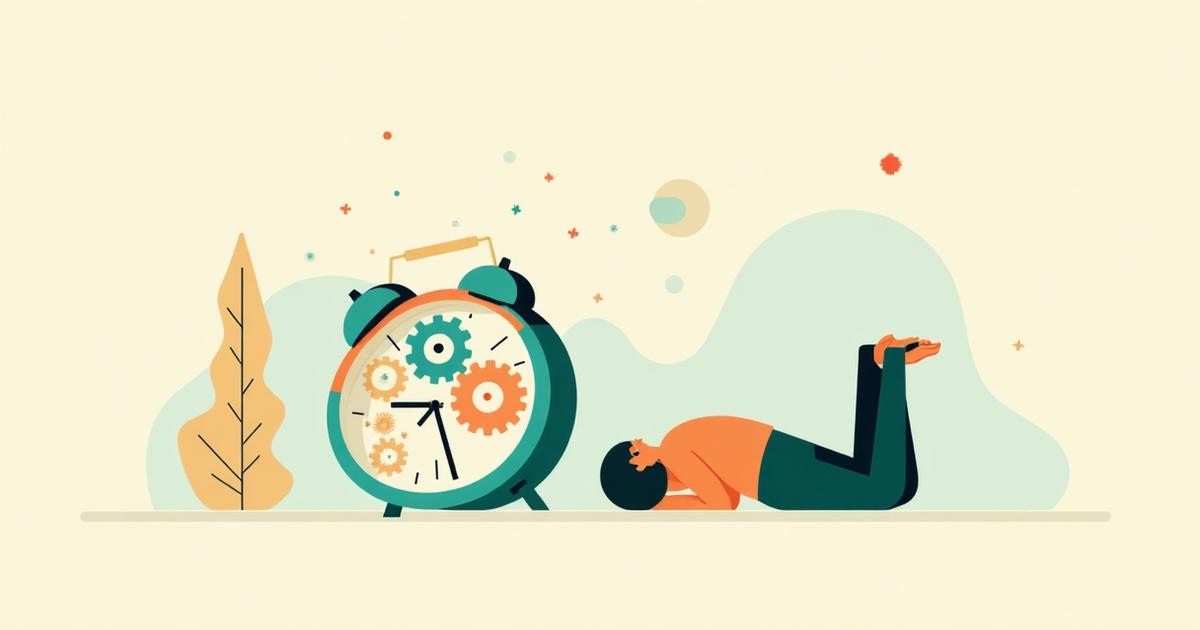
On a Morning I Wanted to Hibernate, I Found a Flaw in Society's Design
I'll be honest — there's a good chance this will turn out to be a rambling record of scattered thoughts.
One winter morning, I was unusually sleepy, reluctant to get out of bed, and on impulse I asked an AI: "Do humans hibernate?"
I think what I really wanted wasn't information — I wanted a scientific name for that feeling of "this is rough." From there, I ended up talking for about three hours, and what I ultimately arrived at was the topic of "society's design philosophy." So I figured I'd write it down.
The First Question: It's Not Wrong to Be Sleepy in Winter
Humans don't hibernate. But it's true that drowsiness increases in winter.
During my conversation with the AI, I learned that the secretion time of melatonin — the sleep hormone — extends as daylight hours shorten. When morning light is weak, the body clock doesn't reset easily, making it harder to wake up. Some studies have found that people sleep 30 minutes to an hour longer in winter than in summer.
So I wasn't being lazy after all.
When I realized that, the next question emerged:
Why does society ignore this biorhythm?
150 Years of Humans Adapting to Machines
From here, the conversation expanded rapidly.
I learned for the first time that during Japan's Edo period, a timekeeping system called "temporal hours" was used. Days were divided based on sunrise and sunset, so in summer each "hour" was longer, and in winter shorter. Time itself stretched and contracted with the seasons. People would "wake at dawn-six and finish work at dusk-six" — a life completely disconnected from minute-level precision.
That changed rapidly from the Meiji era onward.
The Western 24-hour system was introduced in 1873, and the railway's opening in 1872 became the starting point for a culture of "keeping time to the minute." Military conscription and army education ingrained "punctuality = virtue" across the nation, and postwar economic growth pushed it to its extreme. (I pieced together this history through my conversation with the AI.)
Considering that just 150 years ago, the length of time changed with the seasons, the gap with today's "minute-by-minute managed society" is staggering.
The People Who Built This Structure
Tracing back through history, several figures and groups emerge. This too came from the conversation.
First, the Benedictine monasteries (6th century). The prototype of "managing people by time" was, surprisingly, created by religion. Days were strictly divided into prayer, labor, and sleep, with bells moving everyone in unison. The idea that "keeping time is service to God" became the philosophical foundation for later factory management.
Next, Richard Arkwright (18th century). During Britain's Industrial Revolution, he ran water-powered spinning mills and managed hundreds of workers in rotating shifts. It was the first time craftsmen and farmers, who had previously worked at their own pace, were forced to follow "someone else's clock."
Then Frederick Taylor (1856–1915). The founder of "scientific management," he established methods for measuring workers' movements down to the second with a stopwatch to "optimize" them. At the root of this philosophy was a fundamental distrust of workers — the belief that left alone, they would slack off.
Henry Ford (1863–1947) then perfected this with the assembly line — a system where the speed of the machine completely dictated human rhythm.
The importation to Japan was led by Fukuzawa Yukichi, who spread the idea that "precise time management is proof of civilization." After the war, Taiichi Ohno of Toyota crystallized it into the Toyota Production System — "not a single second of waste allowed."
A single thread connects them all.
Monasteries → medieval merchants and clock towers → Arkwright's factories → Taylor's stopwatch → Ford's assembly line → Fukuzawa's modernization philosophy → the Toyota Production System. Along this continuum, humans gradually surrendered "their own time."
What makes this tricky is that the people who built this structure had no malicious intent. Taylor genuinely believed "this benefits the workers too." Fukuzawa advocated time discipline from a desire to "make Japan prosperous." The accumulation of what was considered "rational and correct" in each era created today's society. That's why "defeating someone" won't solve anything.
The Meaning of "Increasing Productivity" Has Been Distorted
When discussing these topics, the word "productivity" naturally comes up.
In Japan, "increase productivity" almost automatically means "work more" or "work more efficiently." But that's wrong by definition.
Productivity is the ratio of output to input. If you can achieve the same results in less time, productivity has increased. If a four-day workweek produces the same revenue, that is increased productivity. Yet in Japanese discourse, "productivity improvement" gets swapped for "try harder."
According to OECD statistics (which I confirmed with the AI), Japan's labor productivity per hour has long been at the bottom among G7 nations, while annual working hours remain high. The reality is "working long hours without producing results" — making people work even longer doesn't address the root cause.
Germany and Denmark work far fewer hours per year than Japan but have higher hourly productivity. They're not trying harder than the Japanese — the structure is different.
The Part About "Waste" That Really Clicked
Of everything in our conversation, this is what resonated most personally.
The question: "Isn't it better in the long run to spend money on things that don't immediately make money?"
The internet was originally a byproduct of military research — nobody was thinking about commercial use. GPS too. Penicillin was discovered by accident from a failed experiment. If investment had only gone to research with immediately visible returns, none of these would have been born. (These examples came up in my conversation with the AI; the details may need separate verification.)
Google's "20% rule" is the same idea. The system of using 20% of work time for free exploration reportedly gave birth to Gmail and Google Maps. Without margins, nothing new is born.
This isn't just about R&D. Build a park. It doesn't contribute to GDP immediately. But children play there, elderly people walk, people interact — health is maintained, community is born, medical costs decrease. Libraries, art museums, festivals, "time doing nothing" — they all share the same structure.
Just as nature has winter, economies may need "time to plant seeds and wait patiently" for true prosperity to emerge.
And Japan should have the room for that waiting.
The Contradiction of the World's Largest Net Creditor Nation
Here, I want to note a fact that came up in our conversation.
Japan has been the world's largest net creditor nation for over 30 consecutive years, with approximately 470 trillion yen in net foreign assets (based on Ministry of Finance statistics; details need verification). Investment income from abroad exceeds 30 trillion yen annually. Japan's structure is already shifting from "a country that earns by working" to "a country whose assets earn for it."
The question "Why are the citizens of the world's largest net creditor nation so exhausted?" best captures Japan's current contradiction.
The money is there. The technology is there. What's missing is a societal consensus that "we no longer need to run ourselves ragged" and a mechanism for converting that wealth into quality of life for citizens.
As long as we keep trying to pour more water into a bucket with holes, nothing will change.
Are "Programmed Humans" Happy?
Midway through our conversation, this thought experiment emerged:
What if humans were programmed to act precisely without ever looking at a clock — and weren't even aware they'd been programmed to do so? Would that be happiness or unhappiness?
At first glance, it seems ideal. No stress about being late, no hassle of schedule management. But when I noticed this, it became slightly frightening.
A person chained knows they are unfree. But a person whose chains have become invisible believes they are free. Which is the deeper unfreedom?
Taylor managed workers' movements from the outside. But the state described in this thought experiment is one where that stopwatch has been implanted inside the human. No manager needed. No surveillance camera needed. Humans have become their own managers.
What's frightening is that this isn't entirely hypothetical. Most people's bodies react with "time to go" without looking at a clock. Sunday evenings bring a vague melancholy. Even during vacation, "Monday" intrudes on consciousness. We may already be programmed to a considerable degree.
However, I realized something here. The perspective that "for many people, being programmed might actually be happier" can't be dismissed.
A life where you must decide every morning "should I work or rest today" is exhausting in its own way. Waking at a set time, taking the same train, doing the same work — many people genuinely find that easier, and that's not weakness. Zen monastery training is conducted under extremely strict time management, yet monks find freedom precisely within that framework.
If that's the case, perhaps the problem isn't "whether we're programmed" but "who did the programming."
A routine you chose for yourself and a framework inserted without your knowledge are indistinguishable from the outside. But the inner experience must be completely different.
What we truly need may not be "removing the program" but rather "being able to choose, yet not having to."
The Story of "Promises" in an Era Without Clocks
This might seem like a digression, but it's what left the deepest impression.
In an era without clocks, promises weren't "tomorrow morning at seven" but "when the rooster crows," "when the sun rises," or "when the market opens." Under the Edo period's temporal hour system, one "hour" corresponded to roughly two modern hours, so "let's meet at noon-four" meant "sometime between 10 and 12." A two-hour window.
The concept of "being late" was entirely different from today.
And the shape of trust was different too. In today's society, "keeping time" is proof of trustworthiness. Someone who's five minutes late can't be trusted — that's the feeling. But in an era without clocks, trust wasn't about temporal precision but about more essential things: "Do they follow through on what they say?" "Will they help when I'm in trouble?"
"That person can be trusted" meant not "someone who arrives on time" but "someone who actually delivers the harvest they promised."
Perhaps letting go of the clock means reclaiming the "trust" we've deposited in temporal precision and returning it to human relationships themselves.
In the End, It's About Systems Adapting to Humans
To sum up this long discussion, I think it comes down to this:
Starting from hibernation, through biorhythms, school start times, the history of time management, the definition of productivity, investing in "waste," the contradiction of net foreign assets — it may look scattered, but at the root, it was all the same question.
Should systems adapt to humans, or should humans adapt to systems?
The current structure is completely reversed. Individuals adapt to companies, companies adapt to national economic policy, nations adapt to global competition. At the end of the line, individuals sacrifice their bodies and rhythms to conform.
Personally, I practice "rest when tired, work when you want to work" in my own life. I can't change all of society immediately, but I can loosen things within a five-meter radius around myself. If a friend is five minutes late, I laugh it off. I don't demand perfection of myself either.
Feeling "I don't want to go" on Monday morning. Thinking "isn't this wrong?" on a packed train. Feeling "sleepy" on a winter morning. I think these discomforts are signals — signals that "my natural rhythm and society's rhythm are misaligned."
Being able to keep feeling these signals is probably what matters.
Because a perfectly programmed human wouldn't even think to ask such questions.
Do you actually trust your own feelings of "I'm sleepy," "this is hard," or "something's off"?
Related Books
Here are some books for thinking more deeply about the "productivity" and "societal design" themes explored in this article.
Was this article helpful?

If this article helped you organize your thoughts
a coffee-sized support would be much appreciated.
※ This is separate from tipping, but—
If you'd like to organize similar themes in your own context, I also offer dialogue sessions as a form of thought organization.
Recommended for you