Strategic Troubleshooting - The DECSAR Method
Introduction
Hello, I'm Yuto Takashi from TIELEC Inc.
In this article, I'll introduce the DECSAR Method, a structured methodology for strategic troubleshooting.
For those of you in infrastructure operations, troubleshooting can be challenging, right? The DECSAR Method is a strategic framework that systematically organizes troubleshooting approaches from an academic perspective. If you're struggling with how to approach troubleshooting, this article is for you.
2026 January Update: Added a practical example from an actual Jenkins EFS incident response.
The DECSAR Method
What is the DECSAR Method?
The DECSAR Method is a troubleshooting approach consisting of six steps. It was developed by Craig Ross and R. Robert Orr as a standardized methodology to help students effectively learn troubleshooting techniques.
The Six Steps of DECSAR
- Defining the problem
- Examine the Situation
- Consider the Causes
- Consider the Solutions
- Act and Test
- Review Troubleshooting
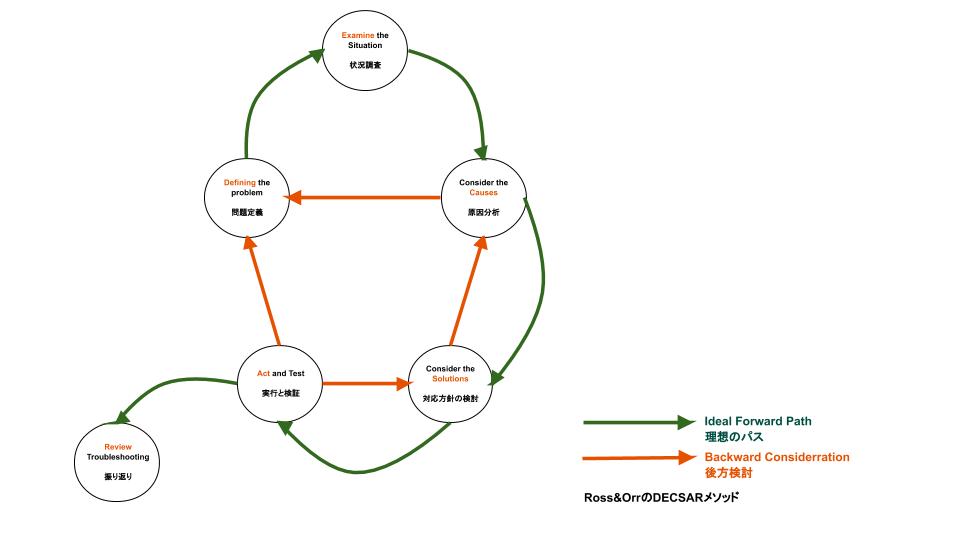
The acronym DECSAR comes from the first letters of each step.
Let me explain each step in detail.
Defining the Problem
In the first step, you define the problem. The troubleshooter carefully considers the cause of the system malfunction to maximize the chances of finding an effective solution.
Examine the Situation
In the second step, the troubleshooter observes the entire system, paying attention to both what is functioning correctly and what is not, and documents findings for later review.
Consider the Causes
In the third step, you consider the causes of the problem. The troubleshooter presents multiple possible reasons for the system failure and ranks them according to the likelihood of being the root cause.
Consider the Solutions
In the fourth step, you consider solutions to the problem and rank them similarly to the cause analysis. You also verify that alternative troubleshooting approaches are available in case the first solution fails.
Act and Test
In this step, the solution is implemented and its effectiveness is verified. The results after implementing the solution are compared with the observations from the situation examination.
Review Troubleshooting
Finally, once the system is repaired, the troubleshooter strives to deepen their understanding of the system to handle future incidents more smoothly.
Practical Example: Complete DECSAR Process in Jenkins EFS Issue
Let's examine how the DECSAR Method functions in actual incident response, using the Jenkins EFS issue that occurred in January 2026 as an example.
Problem Overview
On Monday morning, Jenkins became slow, Git clone operations failed, and 504 errors were frequent. Through approximately three days of investigation and response, we identified the root cause and implemented a permanent solution.
Each DECSAR Step
1. Defining - Problem Definition
What happened: We moved from a vague sense of "it's slow" to a specific problem definition: "Jenkins overall is slow and Git operations are failing."
Key point: By observing multiple symptoms (slowness, errors, timeouts), we identified the common underlying problem.
2. Examine - Situation Investigation
Observations:
- EC2 CPU utilization: Normal at 0-5%
- Network I/O: Normal
- EFS throughput utilization: Frequently spiking to 100% (decisive evidence)
- EFS storage capacity: Increased from 14GB to ~17GB
Key point: We comprehensively checked CloudWatch metrics and recorded both normal and abnormal aspects.
3. Consider the Causes - Cause Analysis
Evolution of hypotheses:
- Initial hypothesis: Temporary network issue
- As investigation progressed:
tmp_pack_*(Git temporary files) accumulated to ~15GB - Deeper analysis: From Burst Credit Balance graph, problem surfaced on 1/26, but root cause originated on 1/13
Final causes (compound):
- Shared Library caching was disabled (primary culprit)
- Change to disposable agent mode (1/13, contributing factor)
- Increased development activity after New Year (more builds)
Key point: By analyzing graphs chronologically rather than just surface symptoms, we reached the true root cause.
4. Consider the Solutions - Solution Planning
Solutions considered and decisions:
| Solution | Decision | Reasoning |
|---|---|---|
| Continue Burst mode | ❌ | Investigation difficult with credit depleted |
| Provisioned 300 MiB/s | ⚠️ Emergency | High cost ($69/26h) but allows investigation |
| Elastic Throughput | ⚠️ Temporary | Surprisingly costly ($8/day) |
| Enable Shared Library caching | ✅ Permanent | Root solution |
Key point: We considered multiple options from emergency response to permanent solution, clarifying trade-offs.
5. Act and Test - Implementation and Verification
Action taken: Enabled Shared Library caching (Refresh time: 180 minutes)
Results:
- Before: Throughput utilization frequently spiking to 100%
- After: Throughput utilization stable near 0%, with regular small spikes every 3 hours (as configured)
Key point: We compared metrics recorded during situation investigation with post-solution results, verifying effectiveness quantitatively.
6. Review - Retrospective
Technical learnings:
- EFS metadata IOPS characteristics
- Jenkins caching mechanisms
- Throughput mode selection
Process learnings:
- Emergency decision-making (make decisions without perfect information)
- Investigation approach (view graphs chronologically)
- Accountability (verbalize decision processes, share failures)
Future actions:
- Enhanced monitoring (alert when EFS throughput utilization > 75%)
- Plan to return to Burst mode
- Continued operation of cleanup jobs
Key point: Rather than just solving the problem, we verbalized it as organizational knowledge and implemented recurrence prevention measures.
Detailed Chronicle
For detailed coverage of this entire response, see our four-part series:
- How Jenkins Gradually Stopped Git Cloning - Problem discovery and emergency response
- Spending $10,000 on Provisioned Throughput - Dealing with costs
- Jenkins & EFS Continued ― Problem Surfaced on 1/26, But Root Cause Was on 1/13 - Root cause discovery
- SRE Work ― From Problem Discovery to Permanent Solution and Results - Final report and retrospective
Summary
Let me summarize the key points.
The DECSAR Method is a troubleshooting approach consisting of six steps:
- Defining the problem
- Examine the Situation
- Consider the Causes
- Consider the Solutions
- Act and Test
- Review Troubleshooting
Troubleshooting skills are essential for IT professionals, but many find them abstract and difficult to master.
Why not start by incorporating the DECSAR Method as a framework for approaching your troubleshooting tasks?
Even in actual incident response, being conscious of this framework makes it easier to grasp the overall picture of the problem and find effective solutions.
Related Books
Recommended books for those who want to learn more about troubleshooting and SRE:
References
- Teaching structured troubleshooting: Integrating a standard methodology into an information technology program
- Training in Troubleshooting Problem-Solving: Preparing Undergraduate Engineering Students for Industry

Was this article helpful?

If this article helped you organize your thoughts
a coffee-sized support would be much appreciated.
※ This is separate from tipping, but—
If you'd like to organize similar themes in your own context, I also offer dialogue sessions as a form of thought organization.
Recommended for you