Why Claude Code Agent Teams Should Be Understood Through Organizational Theory
In February 2025, Anthropic released Claude Opus 4.6. Among various updates—expanded context windows, improved coding performance—what struck me most was the new Agent Teams feature.
As I dug into the mechanism, one thing became certain:
This isn't merely technical evolution. The same structural transformation that occurred in organizational development theory is happening in the AI agent world.
With my engineering career plus HR experience, I've long been interested in organizational theory—particularly Teal organizations and holacracy. That's why when I saw Agent Teams' design, I immediately recognized it: "This is a self-managing organization itself."
And when I overlaid it with Buurtzorg's case, I saw how organizational theory offers surprisingly concrete insights for AI agent operation design.
Starting from technology, passing through organizational theory, to industrial structure transformation. The scope is broad, but this felt like the right moment to accelerate, so I compiled it into one article.
What Agent Teams Actually Is
First, the technical side.
Claude Code previously had subagents. A parent agent delegates tasks to children: "go investigate this," receives results, then issues the next instruction. A parent-child relationship.
Agent Teams fundamentally changed this.
What's different?
In subagents, children operate within the parent's session. Context is shared with the parent. Children don't even know about each other. The parent controls everything, processing is basically sequential.
In Agent Teams, each member has an independent session. They have their own dedicated context window. Members can directly communicate with each other. They pull tasks from a shared task list themselves. True parallel execution.
Anthropic's official announcement explains: "Rather than having one agent sequentially process tasks, work can be divided among multiple agents, each handling their part while directly coordinating."
Currently provided as Research Preview, enabled via environment variable CLAUDE_CODE_EXPERIMENTAL_AGENT_TEAMS=1. It excels at read-heavy tasks—code reviews, security audits. Conversely, when multiple agents modify the same file, conflicts easily occur, and single agents are more reliable.
This "has strengths and weaknesses" point actually connects to the next topic.
This Is Organizational Development Theory Itself
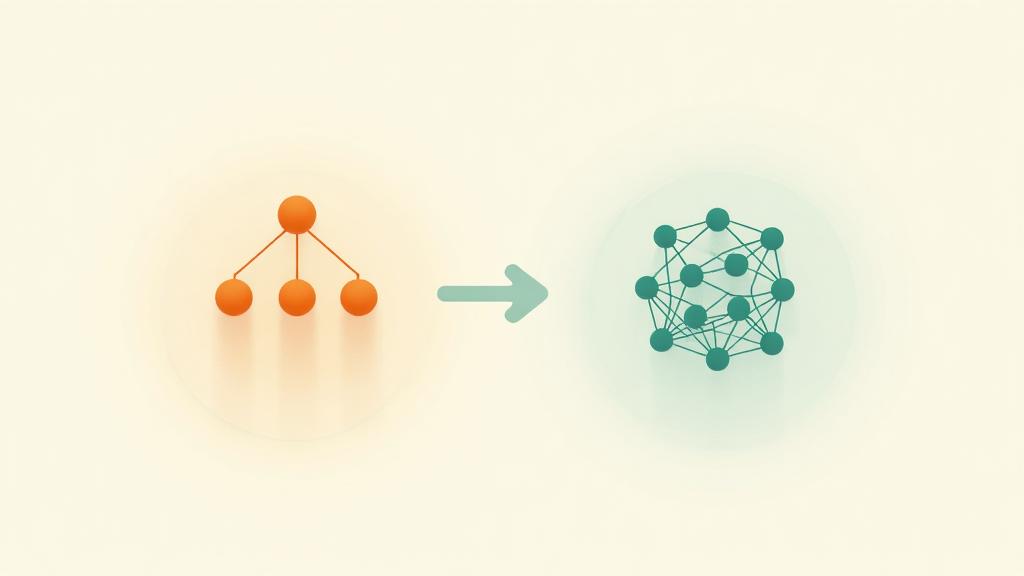
Look at the subagent structure. The parent controls everything, issues instructions to children, receives reports, decides next steps. Children have no lateral connections.
This is a top-down hierarchical organization.
What about Agent Teams? The leader shows direction, but members pull tasks themselves. Members directly discuss with each other, review each other's outputs.
This is a self-managing organization.
Here's the trap. Stopping at "ah, distributed" misses the essence.
Hierarchical and self-managing each have clear strengths and weaknesses. Hierarchical is fast when goals and solutions are clear. But poor at adapting to change. Self-managing doesn't function without high individual judgment. But when that's satisfied, it becomes quite a strong team.
So why did Agent Teams become viable now?
Because Opus 4.6's model performance improved. Terminal-Bench 2.0: 65.4% (Opus 4.5 was 59.8%), OSWorld: 72.7% (same 66.3%). Scores on agentic tasks significantly improved. Meaning "individual agent judgment reached a level that can withstand self-management."
This overlaps with the framework Frederic Laloux showed in "Reinventing Organizations." Teal organizations and holacracy are theoretically beautiful. But practicing them requires high judgment and autonomy from all members. So only a few organizations could do it.
The same thing happened in the AI agent world. Only after model capability crossed a threshold did self-management become viable.
The C Compiler Project as Proof
The C compiler construction project by Anthropic researcher Nicholas Carlini most vividly demonstrated Agent Teams' power.
Scale first: 16 agents. About 2,000 Claude Code sessions. 2 billion input tokens and 140 million output tokens. API cost around $20,000. 2 weeks. Output: a 100,000-line Rust compiler that can compile Linux 6.9 for x86/ARM/RISC-V. Can also compile QEMU, FFmpeg, SQLite, PostgreSQL, Redis. 99% pass rate on major tests including GCC torture test suite. Clean-room implementation with zero internet access during development.
A scale that traditionally would have required a team of dozens of engineers. One researcher achieved it with an agent team.
This project's design is extremely interesting from an organizational theory perspective.
CLAUDE.md = Mission, Vision, Values
In Agent Teams, each member loads CLAUDE.md at startup. "What to build," "design philosophy," "principles to uphold." In Carlini's project, this consolidated: "write in Rust without dependency libraries," "have an intermediate representation that facilitates code optimization," "be able to compile the Linux kernel."
The organization's MVV itself.
Test Suite = Behavioral Guidelines Concretized
With just principles, agents run in arbitrary directions. So what Carlini focused on most was test harness design. Objective criteria: "satisfy this and you're OK." If existing features break, CI fails. "Do freely. But don't cross this line."
Carlini himself writes in the article: without nearly perfect test verification accuracy, agents "solve the wrong problem."
Surprisingly, this is key. In self-managing teams, the precision of behavioral guidelines directly determines outcome precision.
"Mostly Walked Away" = Servant Leadership
The article title says "mostly walked away." But not complete abandonment.
Observing test failure patterns, adding new tests. When everyone swarmed the same bug during Linux kernel compilation, introducing GCC as an oracle (correct answer standard). In some cases, building a CI pipeline so new commits can't break existing code.
Don't dictate methods. But arrange the environment.
This reminded me of one organization's case.
What Buurtzorg Teaches Us
Buurtzorg. A Dutch home care organization founded by Jos de Blok in 2006.
Over 10,000 nurses. About 900 self-managing teams. 10-12 members per team. Zero managers. The case with the most pages in Laloux's "Reinventing Organizations," the best proof that self-managing organizations can scale.
This organization's mechanisms and Agent Teams' correspondence overlap surprisingly concretely.
Performance Transparency → Test Suite
Buurtzorg has an ICT system called "Buurtzorg Web." Nurses can check data on the quality of care they provided and treatment time. Not evaluated by supervisors—data becomes a mirror for self-awareness. Work hours are tracked, but not for management, for team self-monitoring.
Exactly the same structure as test suites and CI pipelines in Agent Teams. With transparent feedback loops, self-correction happens even without supervisors.
Peer Review → Inter-Agent Review
In Buurtzorg, consensus decision-making within teams and solution-focused communication are included in basic principles. Quality is supported not by top-down evaluation but lateral feedback.
The same happens in Agent Teams. In Opus 4.6 cybersecurity investigations, it won against Claude 4.5 model in 38 out of 40 cases. Each test used up to 9 subagents and over 100 tool calls, with agents challenging each other's findings.
Coach ≠ Manager → Human Role
Buurtzorg has about 20 coaches. But strictly support roles. Coaches' work centers on helping teams function, more than advising on patient care. Facilitate when discussions stall, pose questions. Don't solve problems. Arrange an environment where they can be solved.
Back office is also about 50 people. Extremely small for a 10,000-person organization.
Carlini's behavior has exactly the same structure.
Minimal Rules and Maximum Discretion → CLAUDE.md
Buurtzorg's basic principles are just four: solution-focused communication, solution-focused meetings, consensus decision-making, role division and rotation.
Not detailed manuals—establish a few principles, then delegate.
CLAUDE.md is the same. Not "write this function this way," but "have an internal structure that facilitates optimization," "don't break existing tests." Principle-level guidelines only.
The Paradox of "Quantifying Trust"
At the root of Buurtzorg's self-management functioning is trust.
Jos de Blok advocated "humanity above bureaucracy." Trust field nurses, delegate authority. The result: simultaneously achieved management cost reduction and quality improvement. Conversely, without trust, you can only bind with orders and rules.
Here an interesting paradox unique to AI agents emerges.
In human organizations, building trust takes time. So transitioning to self-management is difficult. But what about Agent Teams? Whether model capability is at a "trustworthy level" can be objectively measured by benchmarks.
Carlini also writes in the article: with previous Opus 4 models, only barely functional compilers could be created. 4.5 first reached a level passing test suites. 4.6 enabled compilation of large-scale projects.
The "trust cultivation" that takes years in human organizations can happen overnight in the AI world through model version upgrades.
This isn't just about efficiency. The challenges Buurtzorg solved in human organizations—self-awareness through transparent data, peer review culture, coaches who arrange environments without intervening, minimal principles with maximum discretion—can be directly applied to AI agent operation design.
The Organizational Form Beyond
Beyond self-management. Overlaying organizational theory's flow with AI evolution reveals several directions.
Ecosystem type. Current Agent Teams are one team within one project. But what if, across multiple projects, one team's output becomes another team's input? Feedback loops emerge? Similar to how Amazon's forcing internal APIs resulted in each team becoming essentially an independent service.
Stigmergy type. The coordination seen in ant colonies. Individuals don't talk directly—they coordinate indirectly by leaving traces in the environment.
Carlini's project already has this element. Each agent writes lock files to the current_tasks/ directory, updates progress documents. Other agents read these and decide next actions. Not direct conversation—coordination through a shared environment.
Meta-organization. The future optimal solution probably isn't "one organizational form." Organizational form itself switches depending on situation. Simple bug fix? Subagent. Complex feature development? Agent Teams. Project-wide direction shift needed? Ecosystem reconfiguration.
As Laloux showed, organizational development stages aren't "newer is better." On battlefields, military type is optimal. In factories, process management type is rational. Agent Teams already has the finding that "for write-heavy tasks, single agents are more reliable."
What matters is being able to choose the optimal form for the situation. Human organizations find this difficult due to inertia and baggage. But AI agents don't have that. So they might realize "meta-organization" first.
And from there, something might feed back to human organizational theory.
When Industrial Structure Changes
A bigger story.
Why were large corporations strong? Economics of scale and reduced coordination costs. Governing thousands requires hierarchical structure. Maintaining it costs. Large corporations that could bear this had advantages.
In Ronald Coase's transaction cost theory, firm boundaries are determined by cost structure. If that cost structure changes, optimal firm size changes too.
If Agent Teams drastically lower coordination costs, what happens? Small organizations can handle complex projects on par with large corporations.
The C compiler example is exactly this. One researcher created a 100,000-line compiler for $20,000. Carlini himself writes "a fraction of the cost of creating it myself."
Another important perspective exists.
The possibility that AI elevates hierarchical organizations to self-managing level.
Teal organizations only established in some elite groups because they demand high judgment from everyone. But if AI agents enter each field and can judge "what should be done here and now" while understanding the overall context? Middle management's role shifts from management/transmission to environment design/vision formulation.
At Buurtzorg, problems traditional hierarchical care organizations faced—nurses' loss of autonomy, declining care quality, rising turnover—were solved by transitioning to self-management. Nurses' annual care hours per person are significantly less than other organizations, yet patient satisfaction is top-class among over 300 nursing providers in the Netherlands. Reduced management layers while raising quality.
AI agents could bring the same structural change to more organizations.
The Industrial Revolution replaced physical labor with machines, creating factory systems. The Information Revolution lowered communication costs, enabling global corporations. What's happening now might be a turning point where declining judgment and coordination costs redefine organizational nature itself.
What Must Not Be Forgotten
However, shadows exist behind light.
The concern Carlini wrote at the article's end: "massive amounts of code no one verifies the contents of will emerge."
Opus 4.6 has the capability to discover over 500 unknown high-severity vulnerabilities in open source code. A powerful weapon for cyber defense, but the same capability can be used by attackers—duality. Anthropic developed six new cybersecurity probes and implemented real-time exploitation blocking.
When self-management runs amok, how to control it? Can social systems and regulations keep up with the speed of industrial structure change?
Buurtzorg answered this question with multilayered mechanisms: transparent data, peer review, coaches, minimal principles. Agent Teams also shows the same structure: test suites, mutual review, human coaching, CLAUDE.md.
What's technically possible vs. what society is prepared to accept. How to bridge that gap? This governance design will determine whether the turning point lands in a good direction.
What I Thought While Writing This
When I started investigating Agent Teams' mechanism, the correspondence with organizational theory was immediately apparent. Subagents are hierarchical, Agent Teams are self-managing. That was structural.
But when I placed Buurtzorg's operational design alongside Carlini's project design, deeper implications emerged.
Transparency-based feedback. Peer review. Coach roles. Minimal principles.
Wisdom practiced over decades in human organizations can be directly used for AI agent operation design. And knowledge gained in the AI world might feed back to human organizational theory.
Pursuing technology while reconsidering it in organizational and social contexts. In that reciprocal motion lies true learning, I felt anew.
Reference: Learning About Claude Code
As foundational knowledge for utilizing Agent Teams, learning Claude Code from basics to practical usage is helpful.
*Note: These books do not include the Agent Teams feature (as it's a new feature from February 2025), but understanding Claude Code's basic usage and thinking approach will enable you to more effectively utilize advanced features like Agent Teams.
Reference: Learning About Organizational Theory
For deeper understanding of self-managing organizations and Teal organizations, the following books are the best references.
By learning both Teal organization theory and Japanese company practical examples, the insights for AI agent operation design shown in this article become clearer.
Download Practical Guide
I've prepared a document that goes deeper into the content of this article and compiles specific best practices for operating Agent Teams in practice.
📄 Agent Teams Best Practices Guide (Markdown)
This guide includes:
- Basic concepts and characteristics of Agent Teams
- Correspondence with organizational theory (detailed structural analysis)
- Buurtzorg patterns and implementation methods
- Practical operation guide (CLAUDE.md design, test suite design, coaching)
- Governance and control design
- Implementation checklist
It's freely downloadable, so please use it as a reference when actually working with Agent Teams.
Was this article helpful?

If this article helped you organize your thoughts
a coffee-sized support would be much appreciated.
※ This is separate from tipping, but—
If you'd like to organize similar themes in your own context, I also offer dialogue sessions as a form of thought organization.
Recommended for you