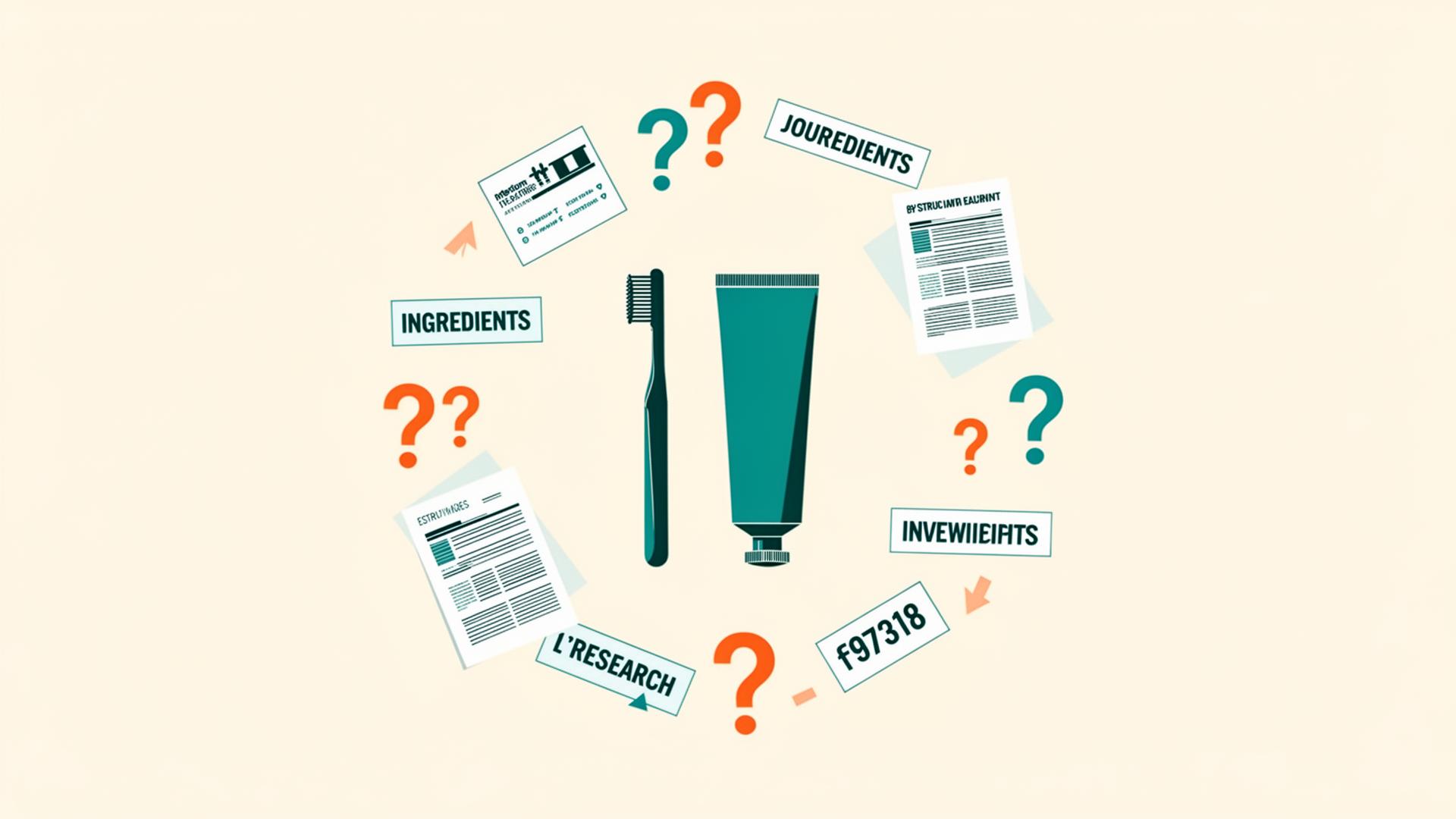
I Brushed Without Toothpaste and Ended Up Researching All the Ingredients
It Started with a Small Question
"I just want to freshen up my mouth a bit."
That thought came after lunch. But since I planned to have coffee later in the afternoon, I didn't want that minty taste. So I tried brushing my teeth without toothpaste.
The result? It felt surprisingly refreshing. It seemed like I cleaned off quite a bit of debris.
"Wait... is toothpaste really necessary?"
This small question became the unexpected entrance to a long journey of exploration.
Physical Cleaning vs. Chemical Prevention
After some research, I learned that for physically removing debris, brushing thoroughly with a toothbrush is most important, and the presence or absence of toothpaste doesn't make that much difference.
I knew fluoride was important for cavity prevention, but then I wondered: what are the fluoride concentration regulations in Japan?
I discovered that the upper limit was raised from 1000ppm to 1500ppm in 2017[1], and furthermore, in 2023, toothpaste with 1450ppm fluoride became recommended even for children aged 6 to under 15[2].
Without me knowing, the world's "recommendations" had been updated.
The Memory of NovaMin
Come to think of it, I remembered. About 7-8 years ago, I heard that "Chinese toothpaste contains superior ingredients."
After researching, I found it was probably "NovaMin," an ingredient effective for tooth sensitivity[3]. However, it hasn't obtained pharmaceutical approval in Japan, so it's not sold here.
"Even if it's a superior ingredient, you can't get it in Japan," I thought. But at the same time, I don't have any sensitivity symptoms. Do I even need it?
Lost in a Sea of Ingredients
"Are there other ingredients besides NovaMin that are effective for cavity prevention?"
From this question, ingredient names kept popping up[4]:
- Xylitol: Cavity-causing bacteria can't metabolize it, so they can't produce acid. WHO studies show 30-80% cavity inhibition effect.
- CPP-ACP (Recaldent): A milk-derived protein. Promotes remineralization.
- POS-Ca (Posca): A uniquely Japanese ingredient discovered from Hokkaido potatoes. Claims to promote "recrystallization."
- Hydroxyapatite: The main component making up 97% of tooth enamel. Developed in Japan in the 1970s.
They all seemed attractive.
Balancing Fluoride and Hydroxyapatite
What particularly caught my attention was the "Apagard" series[5] containing hydroxyapatite.
"Isn't there toothpaste with both fluoride and hydroxyapatite?"
Even after searching, I couldn't find any with both ingredients.
The reason: a 2019 study reported that "both have similar cavity prevention effects"[6], so manufacturers seem to have judged that "either one is sufficient."
Apagard M Plus costs about 1,400 yen. That's 3-4 times the price of typical fluoride toothpaste.
"Is it worth the price?"
After researching, the easily noticeable effect is the "smooth tooth feel," and cavity prevention effects won't be apparent without long-term use.
Many opinions suggest that if cavity prevention is the only goal, a 300-yen toothpaste with 1450ppm fluoride is sufficient.
That's when I realized: "There are other fluoride toothpastes with whitening effects too. Maybe I don't need Apagard."
In fact, products with 1450ppm fluoride + whitening effects can be bought for around 800 yen.
Why Whitening Toothpaste Costs More
"By the way, why is whitening toothpaste a bit more expensive?"
After researching[7], the main reason is the quality difference in abrasives.
Cheaper products use coarse abrasives, while higher-priced products develop ultra-fine particle abrasives that don't damage tooth enamel, which costs more.
I got a bit scared when I read that "cheap whitening toothpaste has the risk of grinding down your teeth."
The Existence of Sensitivity and Periodontal Disease Solutions
"Also, there are somewhat expensive toothpastes even without whitening features. What's in those?"
After researching[8], they mainly contained the following ingredients:
Sensitivity Treatment (800-1,200 yen)
- Potassium nitrate: Blocks nerve signals
- Aluminum lactate: Physically seals dentinal tubules
Periodontal Disease Prevention (900-1,500 yen)
- IPMP: Kills periodontal plaque bacteria
- Tranexamic acid: Suppresses gum inflammation
- Vitamin E: Repairs gum tissue
Total Care Products (1,000-1,500 yen)
- All-in-one type combining multiple functions above
I could see why the price differences exist. They're expensive because they contain specialized ingredients for specific concerns (sensitivity, periodontal disease).
But I don't have these concerns.
What Do I Really Need?
I reorganized my thoughts. What I want from toothpaste:
- Cavity prevention
- Periodontal disease prevention
- Whitening
These three things. No sensitivity symptoms. No special concerns.
"So then, show me a cost-effective toothpaste with cavity prevention, periodontal disease prevention, and whitening features."
After reframing my question and researching[9], several candidates emerged:
- Clinica Advantage Whitening (about 350-400 yen/130g)
- 1450ppm fluoride + periodontal disease prevention ingredients + whitening
- NONIO Plus Whitening (about 600-800 yen)
- Above + enhanced bad breath prevention
- Clinica PRO All-in-One (about 600-900 yen/95g)
- Above + sensitivity prevention
- Systema Haguki Plus Premium Yokubarina Bihaku (about 900-1,100 yen/95g)
- Enhanced periodontal disease prevention + whitening
PRO or Advantage?
Honestly, "Clinica PRO All-in-One" seemed like the #1 choice for overall capability. But comparing prices:
- Advantage: 350-400 yen (130g) → about 2.7-3.1 yen per gram
- PRO: 600-900 yen (95g) → about 6.3-9.5 yen per gram
There's a 2-3x price difference.
PRO's additional feature is mainly "sensitivity prevention." But I don't have sensitivity symptoms.
"If I don't have sensitivity symptoms, isn't Advantage sufficient?"
That was my conclusion.
Final Check: Abrasive Quality
But I had one last concern.
"Clinica Advantage Whitening doesn't fall into that category of low-quality abrasives you mentioned earlier, right?"
After researching[10], Clinica's abrasive is anhydrous silica, with solid quality control from a major manufacturer (Lion). There was an official explanation: "The abrasives in toothpaste are checked for their effects on teeth. If you brush correctly, they won't damage your teeth."
The particle size is controlled in a design called "W Scrub," and reviews show no complaints about grittiness.
I felt reassured.
The Meaning of Taking the Long Way
I took quite a detour in my research, but I learned many things.
Fluoride regulation changes, NovaMin, xylitol, CPP-ACP, POS-Ca, hydroxyapatite, combining fluoride and hydroxyapatite, Apagard cost-benefit evaluation, whitening toothpaste price differences, sensitivity treatment ingredients, periodontal disease prevention ingredients, comparison with Clinica PRO, abrasive quality...
I chased so much information and compared various ingredients.
But what I ultimately chose was the relatively simple "Clinica Advantage Whitening."
"Well, I could have just gone with this from the start."
Part of me thinks that, but without this detour, I probably would have continued choosing toothpaste somewhat randomly.
So while I took the long way around, I'm glad I researched it.
Discovering My Decision Criteria
I realized something through this exploration.
The more information you gather, the more options multiply. You get drawn to ingredient appeal and want to seek "something better." NovaMin, hydroxyapatite, sensitivity prevention, bad breath prevention... they all seemed attractive.
But what's truly necessary is identifying "what's optimal for me."
- I don't have sensitivity symptoms → Don't need NovaMin or sensitivity treatment ingredients
- Cavity prevention effects are similar → No reason to insist on expensive hydroxyapatite
- Three functions are enough → A simple product is sufficient
Within Small Choices
Choosing toothpaste is a trivial everyday decision.
But within it lies "how to engage with information" and "how to identify decision criteria."
When I was about to be drawn to ingredient appeal, I stopped to ask: "But do I really need this?" Calmly comparing price and effectiveness.
The exploration that started from a small question ultimately became an opportunity to think about the power to make my own judgments.
Of course, researching every product this thoroughly would be endless, but don't you think this kind of exploration is interesting once in a while?
Referenced Sources
Fluoride Concentration & Regulations
[1]About fluoride concentration regulations in Japan
[2]About the 2023 fluoride recommendation age change
NovaMin
[3]Research on NovaMin effectiveness
Cavity Prevention Ingredients
[4]Effects of xylitol, CPP-ACP, POS-Ca, etc.
Hydroxyapatite
[6]Comparative study of hydroxyapatite and fluoride
Whitening Toothpaste
[7]About whitening toothpaste abrasives
Sensitivity & Periodontal Disease Treatment
[8]About sensitivity treatment toothpaste / Toothpaste selection guide
Product Selection & Comparison
[9]How to choose cavity prevention toothpaste / How to choose toothpaste / Recommended toothpaste comparison
Clinica Abrasives
[10]Clinica abrasive FAQ / Product reviews / Product information
Was this article helpful?

If this article helped you organize your thoughts
a coffee-sized support would be much appreciated.
※ This is separate from tipping, but—
If you'd like to organize similar themes in your own context, I also offer dialogue sessions as a form of thought organization.
Recommended for you