
Resisting the Word \"Diagnosis\" — Naming and Design Philosophy Disclosure
This may be a somewhat disjointed piece, but having finished building the tool, I want to document my thoughts on the final problem that remained: what to name it.
The Violence of the Word "Diagnosis"
After completing a tool to visualize metacognition and reflective tendencies, the final problem was deciding what to name it.
"Reflective Capacity Diagnosis."
I immediately felt discomfort with this first name that came to mind.
The word "capacity." It implies measuring ability. It evokes hierarchies of high and low. And the word "diagnosis" also carries connotations of pass/fail and good/bad judgments.
After building a design so carefully around "not evaluating," "not elevating," and "not dealing with stages," would the name betray all of that? This was my struggle.
The word "diagnosis" inevitably carries the power to evoke expectations of "scores," "correct answers," and "judgments." No matter how much you write in the description that "this is not an evaluation," the name creates the impression first.
Balancing Clarity and Philosophy
On the other hand, making the name too abstract would fail to communicate what the tool does.
I considered alternatives like "ORIMD Mirror" or "Reflect Map." These have no scent of evaluation and align with the philosophy. But for first-time users, it's unclear what kind of tool it is.
Taking clarity too far is dangerous.
Leaning too far into abstraction fails to communicate.
Within this dilemma, I reconsidered the name many times.
What about "Metacognitive Tendency Diagnosis"?
Using "tendency" instead of "capacity" weakens the sense of high/low or superiority/inferiority. "Diagnosis" is still there, but it has a familiar feel as personality diagnosis or tendency diagnosis that's generally accepted.
But this doesn't reveal the ORIMD framework's philosophy. The unique thinking and context might not come through.
Embedding Philosophy in the Name
What I finally arrived at was: "ORIMD | Metacognition & Reflective Tendency Diagnosis."
The left side, "ORIMD," is the anchor of the unique framework. Its presence shows that this is distinct from general psychological diagnosis, with its own philosophy.
The right side, "Metacognition & Reflective Tendency Diagnosis," is the entry point that lets even first-time users understand what the tool handles. And the word "tendency" is the decisive factor in avoiding ability evaluation.
The separator "|" was also important.
Left side: philosophy and structure. Right side: meaning for users.
This separation felt like it enabled the balance of clarity and philosophy.
But the name alone isn't enough.
I decided to always include a subheading:
Visualize what perspectives you used to perceive this event
And before starting the diagnosis, always communicate this:
This diagnosis does not evaluate the "height" or "capacity" of your metacognition or reflection.
It visualizes what perspectives were used in your responses and reflection as tendencies.
Don't sensationalize with the name. Eliminate misunderstanding with the description.
I felt this was the optimal solution.
The Need to Disclose Design Philosophy
Another dilemma was whether to create a "Design Philosophy Disclosure" page.
Normally, diagnostic tools don't have pages about design philosophy. But I felt this tool needed one.
Because this tool has a design that goes against intuition.
Scores appear. Graphs appear. The word "diagnosis" is used.
Yet it doesn't evaluate abilities. Doesn't hierarchize. Doesn't deal with developmental stages.
Without explanation, it will inevitably be misread.
And I considered this disclosure not an excuse but a "safety mechanism."
The more people understand the design philosophy, the more correctly they can interpret the results.
It prevents misguided self-denial or self-inflation.
I decided on this page structure:
First, state explicitly "what this tool does NOT do":
- Does not evaluate people's maturity or abilities
- Does not compare with others or rank
- Does not assign superiority/inferiority as "high/low"
- Does not deal with adult developmental stages
Defuse all the landmines first.
Next, explain "what it DOES do":
This diagnosis visualizes what perspectives were used in this event or your responses.
Explain each of ORIMD's five perspectives in one line, and carefully explain "why are there scores and graphs?"
Numbers and figures are not for comparison or evaluation, but aids to help awareness.
And touch on the "gap" that this tool values most:
Gaps between self-awareness and behavior are not failures.
Gaps are the entry point to reflection.
Finally, a non-prescriptive closing:
There is no correct answer.
Simply observing this result as "so that's how it appeared" is enough.You don't need to do this multiple times.
You don't need to aim for growth.
You can quit.
So that people who read this page can view their results with peace of mind. So they don't feel evaluated. So they can understand "that's the design."
A Design Without "Perfect Scores"
What happens if someone selects 5 for everything on the test?
When I asked myself this question, I had a realization.
Numerically, all axes become 1.0 (outer edge). The radar chart becomes nearly a perfect pentagon.
But this shouldn't be read as "perfect score" or "complete."
At the same time, if someone marked 5 for everything, they also marked 5 for reverse items.
In other words, the responses for "I generally think my thoughts are correct" and "I think it's fine to mix things up" are also at maximum.
This indicates overconfidence tendency.
On the results screen, we communicate this:
For this perspective, your self-awareness may be appearing stronger than your actual behavior.
That's what "awareness" is.
Even with all axes at MAX, it doesn't become an experience of "growth has stopped."
Rather, you can notice distortions in your own awareness.
This was the design philosophy of this tool.
For technical implementation details, see the following article:

診断ツールに「評価」を持ち込まない(前編: ベーシック診断)——質問票設計の構造的矛盾
Advanced Diagnosis is a "Passage Log"
If the Basic Diagnosis is a "map" of tendencies, the Advanced Diagnosis is a "passage log" of events.
I created a mechanism where users actually do reflective work with the ORIMD framework, and that text is automatically analyzed.
But this also isn't about seeing "how well you can write."
It only observes reflection habits and how you use thinking.
On the results screen, we communicate observation, not evaluation:
This is a record of how you traversed this event.
It does not evaluate your abilities or tendencies.
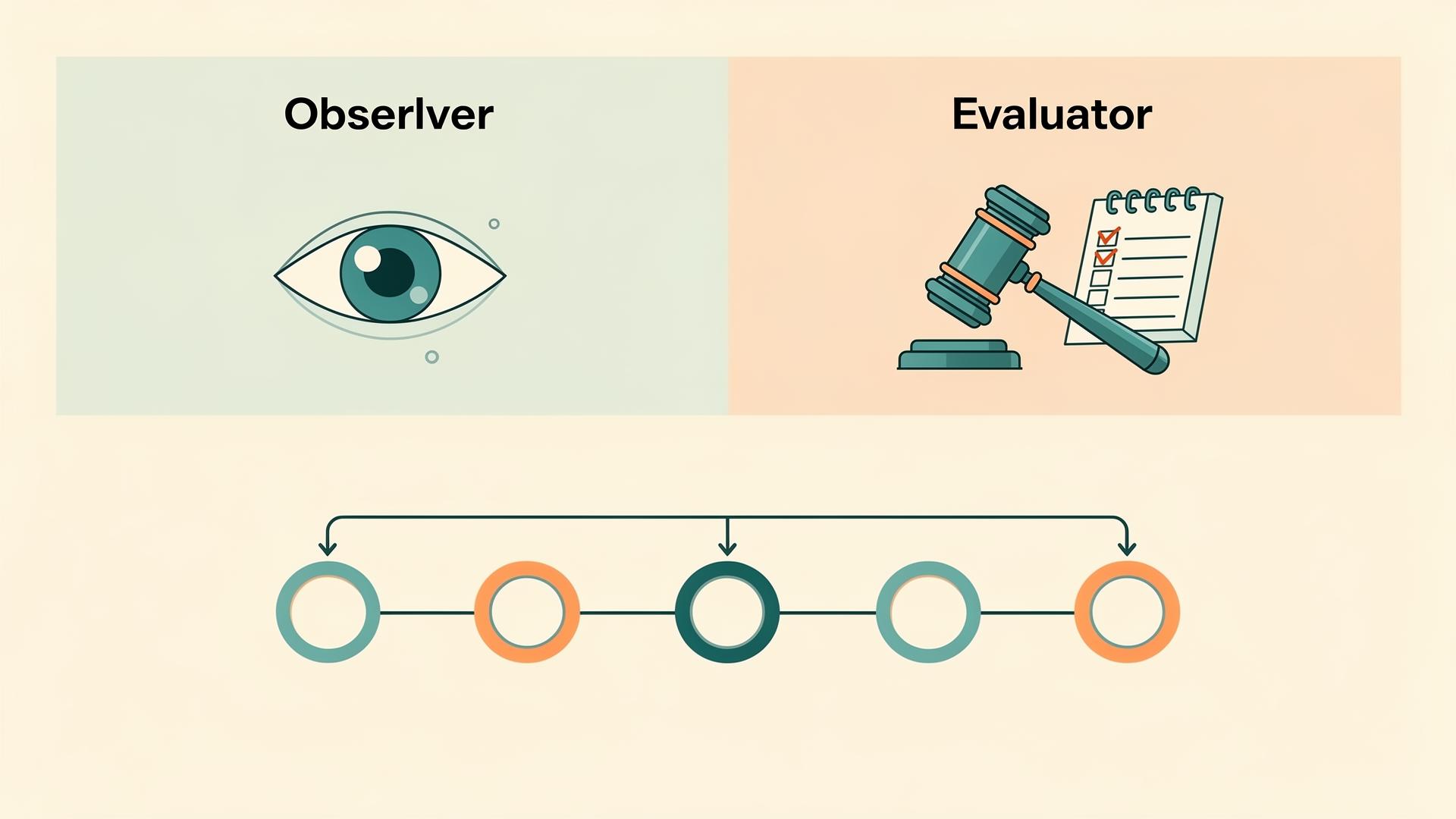
Show ORIMD's five steps as process flow.
Not radar charts, but horizontal alignment or vertical flow.
Each step gets non-hierarchical, non-score expressions like "thoroughly used" or "modest this time."
And observation comments are neutral:
Events are organized chronologically, showing intent to extract them as facts.
No scores. Don't use "can do / can't do."
Even if mixed, don't make that a negative.
Attention to Word Details
After finishing, I realized even finer adjustments were needed.
"This perspective was not used this time"
This expression could be read as "couldn't do it" or "insufficient."
Even though it's a neutral fact of "was not observed" in the analysis mechanism, humans tend to read it as "deficiency."
So I changed it to:
In this reflection, this perspective was less prominent.
Given the nature of the event, other perspectives may have taken priority.
Not "unused" but "not prioritized."
An expression that completely eliminates the scent of ability evaluation.
There was also a problem of R (Emotional Recognition) and D (Decision Making) appearing relatively emphasized.
These perspectives appear more easily in text. So analysis result comments tend to be more affirmative, making O/I/M appear "weak."
As a countermeasure, I made sure all observation comments necessarily include "context-dependent" vocabulary:
In this event, attention to emotions naturally arose more easily in context.
Don't let R/D be read as "can do it."
Don't let O/I/M be read as "can't do it."
Show all axes not as goodness but as "role and center of gravity."
For technical implementation of observation using LLM, see the following article:
診断ツールに「評価」を持ち込まない(後編: アドバンス診断)——LLMを観測者にする技術
Only Those Who Can Trust This Tool Will Use It
The moment I chose the name "ORIMD | Metacognition & Reflective Tendency Diagnosis," I may have entered a path of no return.
I can no longer go toward ethically sloppy directions, developmental stage superiority contests, or maturity business.
But I didn't think that was a drawback.
Because it means the design became one where only those who can trust this product will use it long-term.
The reason I struggled so carefully, chose words deliberately, and disclosed the design philosophy was not to "measure" but to "reflect."
Not "measuring" reflection but "reflecting" it.
This philosophy flows consistently through the name, the description, the results screen, and the details of the words.
I became convinced the release was ready.
The actual assessment tool is here:
https://metacog-assess.tool.tielec.blog/
I felt anew that names embody philosophy.
No matter how carefully you build the design, if the name betrays it, it means nothing.
That's why it was worth agonizing over this much.
Was this article helpful?

If this article helped you organize your thoughts
a coffee-sized support would be much appreciated.
※ This is separate from tipping, but—
If you'd like to organize similar themes in your own context, I also offer dialogue sessions as a form of thought organization.
Recommended for you