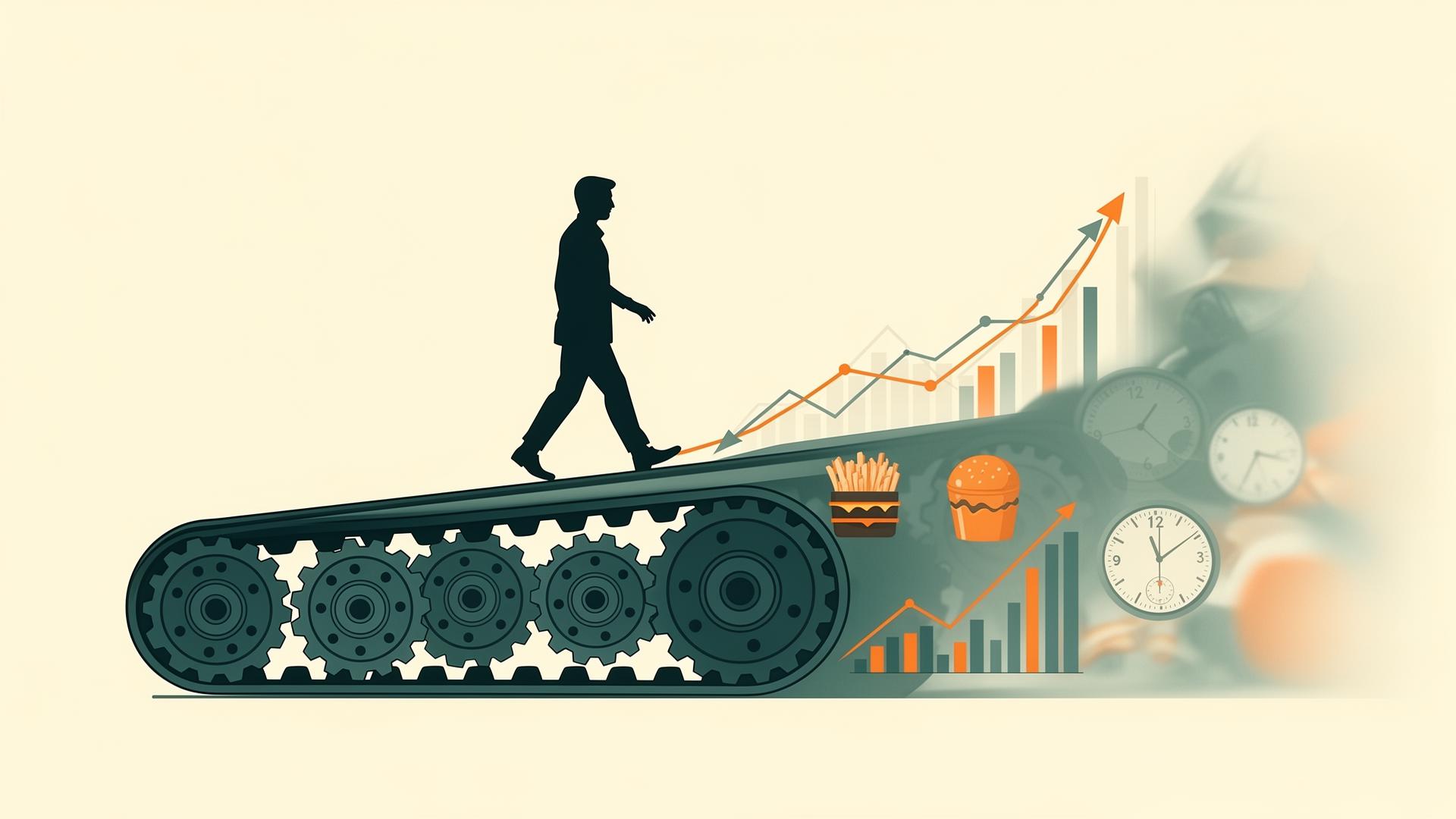
Nobody Is to Blame, Yet Something Is Wrong
The "This Will Do" Choice
During lunch break, when thinking about where to eat, I always end up choosing with a "this will do."
It's not that I have any complaints. It's cheap, fast, and reliable. But somehow, a feeling of "I really wanted to eat something better" lingers in the corner of my mind.
One day, while talking with someone about this feeling, a strange sense of unease was put into words.
Competing on Speed and Systems
They were talking about a certain fast-food chain. "Why does everyone go there?"
In terms of taste alone, other burger chains are definitely better. The price difference isn't that big either. Yet, before you know it, people choose that chain.
The reason is simple: it's overwhelmingly "fast," "everywhere," and "reliable."
That chain doesn't compete on taste. It competes on systems. The same taste, same speed, same experience anywhere in the world. They've spent decades perfecting that system.
Moreover, they're essentially a real estate company, securing prime locations and renting them to franchise owners to stabilize their revenue structure. They're not just competing on burger profits.
On the other hand, another chain that insists on "making delicious hamburgers" hasn't reached that scale. Sure, their performance is steadily growing and they have many fans. But there's an overwhelming gap.
Hearing this story, I felt something indescribable.
For a restaurant, I want the passion of "wanting people to eat delicious food" to be at its core. But from that chain, I don't really sense that. It feels like "how to make people buy" comes first.
Honestly, I thought, "That's not sincere."
However, this might be a one-sided view. I use that chain too. When I'm busy, when I don't have time, I choose it thinking "this will do." I don't regret that choice.
So I don't want to make that chain the villain.
Consumers Are Accepting It Too
What's scarier is something else.
Consumers are accepting it too.
We choose the mechanically produced burger over the carefully crafted one, thinking "this will do." We too are prioritizing "convenient, fast, and reliable" over "truly delicious."
That chain saw through this consumer psychology and optimized for it. In a sense, it's a business that bet on human weakness.
And it succeeded brilliantly.
In fact, that chain is apparently doing incredibly well right now. Despite implementing gradual price increases, nearly doubling prices, customer traffic hasn't dropped. They're even recording record profits.
They're increasing shareholder dividends and rolling out self-order kiosks to streamline store operations. In other words, they're accelerating the "systems over taste," "efficiency over food" approach.
Meanwhile, health consciousness and healthy eating continue as a major global trend. Yet that chain keeps winning.
How do we see this?
That chain has completely seen through the reality that "consumers say health with their mouths but choose convenience with their actions." In a way, that chain might understand human nature most accurately.
Nobody Is to Blame, Yet Something Is Wrong
At that moment, I suddenly thought:
This is just like capitalism itself.
What's similar is the feeling of "nobody is to blame, yet everything is getting poorer overall."
That chain isn't doing anything illegal. Consumers are choosing of their own free will. Employees work because they want to. Shareholders are earning legitimate profits. Nobody is to blame.
But before you know it, mom-and-pop restaurants are disappearing from the streets, "fast and cheap" has become justice, and meals have become like "refueling."
Capitalism is the same way. Individual economic activities are the result of rational, free choices, but looking at the total picture, inequality widens, the environment breaks down, and everyone is busy and exhausted.
"Correct individually, but something is wrong overall" — that structure.
And it's hard to criticize. If someone says "just don't buy it if you don't like it" or "it's your responsibility," that's the end of the conversation.
Blaming that chain won't help, and denying capitalism offers no alternative. But the nagging feeling of "is this really okay?" persists.
Careers Have the Same Structure
Then I realized this isn't just about food.
Careers have exactly the same structure.
Open a job site and you see words like "market value," "skill set," "career path." In engineering circles, there's also "tech stack," "portfolio," "growth environment."
None of these are bad words. They're important perspectives for thinking about careers.
But before I knew it, careers seem to only be discussed in these efficiency-oriented terms.
"Move fast," "deliver results," "grow" — that's justice. You want to do things carefully, but speed is demanded. You end up choosing what looks good on a resume over what you really want to do.
Honestly, I got stuck here.
When I was a company employee, I was always busy. Complete the task in front of me, move to the next task, then the next. Before I knew it, a day ended, a week ended, a month ended.
In those days, I didn't have time to think "why am I doing this job?"
No, more accurately, I believed I didn't have time to think. If I stop, I'll fall behind. If I stop, I'll be left behind. So I had to keep running.
But after running like that, I lost track of who I was.
My career had become "work." Days of just completing tasks in front of me. I forgot "why I chose this job."
When Work Only Partially Matches What You Want
Here, I want to add a note about work not completely aligning with what you want to do.
I haven't always chosen jobs that perfectly match what I want to do. Rather, I've more often chosen jobs that partially match.
For living expenses, to acquire skills, for the next step. I've chosen jobs for those reasons too.
But I don't think that itself is bad. Even with partial matches, you can learn from them and grow. I wasn't choosing things completely different from what I wanted.
The problem is whether you're aware of making such choices.
Choosing with conviction that "this is a partial match, but I need this right now" versus choosing "vaguely" or "going with the flow" are completely different.
The former means you're deciding your own career. The latter means it's being decided for you.
Taking Time to Stop and Think
During a leave of absence, I took time to think carefully.
What do I really want to do? Why did I choose this job? How do I want to live going forward?
I faced these questions deliberately.
The answers didn't come immediately. Even now, I don't have complete answers. But I can keep asking.
And I think continuing to hold these questions might actually be the key.
The Control of Brave New World
While thinking about what this nagging feeling really was, I suddenly remembered a novel.
Aldous Huxley's Brave New World.
This novel, alongside George Orwell's 1984, is known as one of the representative dystopian novels of the 20th century. But the "form of control" they depict is the exact opposite.
1984 is about "control through fear." Surveillance cameras, thought police, torture, censorship. The state makes people obey through violence and fear. People obey because "they're afraid."
On the other hand, Brave New World is about "control through pleasure." People's classes are determined at birth through genetic engineering, they take a drug called "soma" that gives them a sense of happiness, they enjoy entertainment and sex, and live without any dissatisfaction.
Nobody is oppressed. Rather, everyone is happy. But deep thinking, suffering, true love, art, philosophy... these things don't exist. Because they're not needed. People obey because "it feels good."
The world we live in is clearly approaching the latter.
Nobody points a gun and says "go to that chain." Nobody says "choose this job." But before you know it, you're doing exactly that.
Can't stop Netflix. Can't let go of the smartphone. Endlessly scrolling TikTok.
It's not unpleasant — rather, it's comfortable. So there's no reason to resist. No motivation to stop and ask "is this okay?"
The horror of a Huxley-an world is that people come to love their own servitude. No need to break the chains. Because the chains feel good.
Returning to the fast-food story, we're given the comfort of "cheap, fast, and convenient," and in exchange, we're gradually letting go of "the ability to choose truly delicious things," "the patience to wait," "the joy of putting in effort." But we don't feel it as a loss. Because we're not in trouble right now.
Careers are the same. We're given the comfort of "growing efficiently," "increasing market value," and in exchange, we're gradually letting go of the ability to think "why am I doing this job," "what do I really want to do." But we don't feel it as a loss. Because we're not in trouble right now.
This is the horror of "a world taken to its extreme."
By the time you realize it, you can't even remember what you've lost.
Choosing Not to Optimize
So what should we do?
Should we launch big campaigns or movements? Call out "stop going to that chain" or "abandon efficiency-oriented career views"?
No, I don't think so.
Such campaigns ultimately become "forcing correctness." They create backlash and only deepen division.
Moreover, that's playing on the same field as the fast-food chain. In the sense of trying to change people's behavior through big systems. It becomes a battle of "systems that make you go" vs "systems that stop you from going."
The moment you try to "cause" change, that too becomes just another system.
So what I think about is something more personal and quiet.
Consciously choosing "not to optimize."
Knowing there's a fast and cheap chain nearby, deliberately taking time to go somewhere else. It's not rational, but doing it anyway. Individuals gradually giving themselves room to let go of efficiency.
Same with careers. Knowing there are options that raise market value, deliberately choosing "what I need right now." It might not be efficient, but doing it anyway.
Also, "putting it into words and sharing." Just like I'm writing now, putting the "something feels off" into words and sharing with someone. That itself becomes a small force that shakes up values.
And above all, keep asking "is this really okay?"
Stop and think. Reflect.
Consciously make time for that.
A Small Resistance to Living Without Being Swept Away
To be honest, this isn't "a way to change the world."
It's "a way to live with conviction."
In a fast-food world, in an efficiency-oriented career landscape, wanting to at least not be swept away myself.
If we seriously consider overall optimization, we probably need policies, pressure on companies, bigger dynamics. But honestly, I can't see that far.
Also, I wonder. Maybe there's more meaning in chains that insist on "making good things" spreading. Chains that consider people's health have more social significance than fast food. In the sense of creating a flow where "proper things" win within capitalism.
Maybe careers are the same. More companies that value "care" over "efficiency." Environments spreading where "conviction" can be prioritized over "growth."
However, such companies and environments also can't resist the wave of efficiency. It's necessary for survival too. Within capitalist competition, there's almost no option to "not become efficient."
In the end, intention alone to "make good things" can't resist the gravity of the system.
Neither complete hope nor despair. Somewhere in between, we may just have to keep choosing.
And to be even more honest, while thinking all this, I ate a hamburger at a family restaurant that day.
Despite talking about ideals, I ultimately decided based on that day's mood and proximity.
But I think that's human.
Saying "choices are important" and "choose consciously," but ultimately it's decided by that day's mood or proximity. We're that kind of creature, and there's no point denying it.
Rather, if you start thinking "is this really okay?" while eating a hamburger at a family restaurant, that's meaningful in itself.
You can't keep making perfectly "correct choices."
But you can ask "is this really okay?"
And sometimes, you can consciously make a different choice.
That might be enough.
Not losing the power to reflect.
Stopping to think.
That might be the small resistance for living without being swept away in this world.
What are you choosing?
And are you being made to choose?
Was this article helpful?
If this article helped you organize your thoughts
a coffee-sized support would be much appreciated.
※ This is separate from tipping, but—
If you'd like to organize similar themes in your own context, I also offer dialogue sessions as a form of thought organization.
Recommended for you