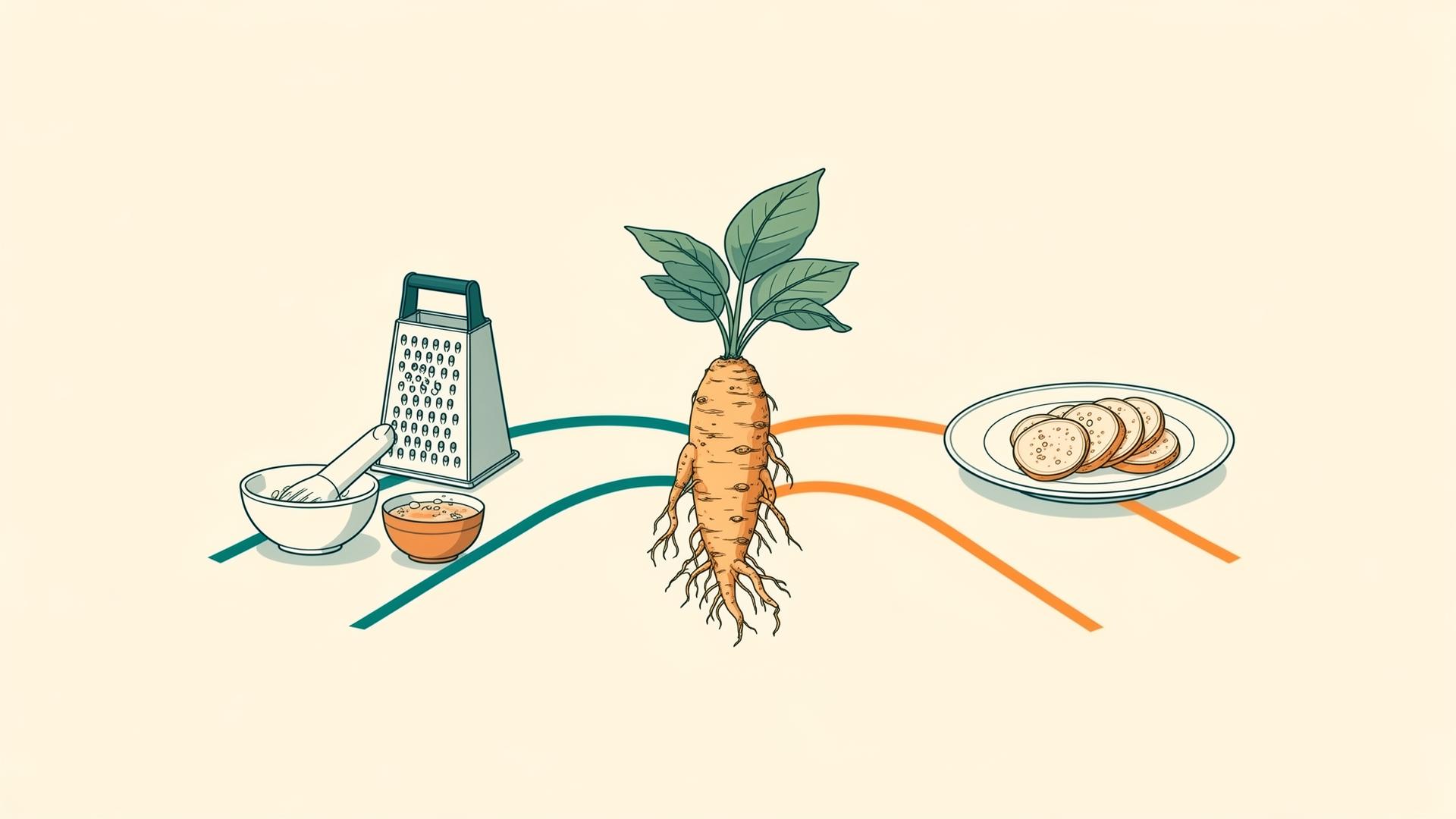
Does It Have to Be Tororo?
The other day, I received jinenjo (Japanese wild yam) as a gift.
It's an ingredient I never buy for myself. I know about nagaimo (Chinese yam) that I see at supermarkets, but this was my first time cooking jinenjo.
I started by researching how to eat it.
My First Jinenjo
According to what I found, jinenjo is typically "prepared by burning off the root hairs and grating it with the skin on."
Root hairs are the fine, hair-like roots on the surface. You quickly burn them off over a gas stove flame. You don't peel the skin—you grate it as is.
Honestly, my first thought was "with the skin on?" I had the image of peeling nagaimo. But jinenjo has thin skin, and the area between the skin and flesh contains lots of flavor and nutrients, so it's better not to peel it. Natural jinenjo has an irregular, bumpy shape that's hard to peel anyway, and it's been eaten this way traditionally.
I followed the instructions. Burned off the root hairs, grated it with the skin on.
What surprised me after grating was how sticky it was. While nagaimo tororo (grated yam) has a smooth, liquid consistency, jinenjo was completely different. It was thick and sticky, almost like you could pick it up with chopsticks.
However, I was concerned about the color. Instead of white, it was grayish, somewhat darkened.
"Did I mess this up?" I wondered, but research showed it was just oxidation-related discoloration—nothing to worry about. When grated with the skin, it's high in polyphenols so it discolors easily, but it doesn't affect taste or nutrition. Enjoying the taste over appearance is part of the jinenjo experience.
I made tororo rice with it.
It was delicious. Completely different from nagaimo.
The Truth About "Yamaimo"
This is when I first learned that "yamaimo" (mountain yam) is actually a general term.
There's no specific variety called yamaimo—it's a collective name for yams in the Dioscoreaceae family. This includes both jinenjo and nagaimo.
Jinenjo is a native Japanese wild variety with the strongest stickiness and rich flavor. It has a long, twisting shape and is rare and expensive. On the other hand, nagaimo is originally from China, has more water content with a crunchy texture, and less stickiness. It's straight and thick—the affordable one you commonly see at supermarkets.
Most "yamaimo" sold at supermarkets is actually nagaimo, so the "yamaimo tororo" I've eaten until now was probably nagaimo.
When I looked up jinenjo prices, even cultivated ones cost about 2,000-4,000 yen per piece. Wild ones can cost 5,000-10,000 yen or more per kilogram. Nagaimo costs about 200-400 yen per piece, so there's a 5-10 times price difference.
The reasons are that cultivation takes 1-2 years, wild ones are labor-intensive to dig up in mountains (they grow deep and twisted, so it's difficult to dig without breaking them), and harvest quantities are low.
Knowing this, I honestly felt I had received something valuable.
What Should I Make Next?
Now, I still have jinenjo left. While it can last 2-3 weeks in the vegetable compartment, I want to eat it while it's fresh.
What should I make next?
Looking it up, there are various ways to eat it besides tororo.
Isobe-age (nori-wrapped fritters), tororo-yaki (grilled grated yam), tororo nabe (hot pot), gratin-style. These are "grate first, then cook" methods.
Sashimi-style strips, tempura, butter-soy sauce sauté, deep-fried, simmered. These are "cook without grating" methods.
Honestly, grating was a bit of a hassle. The strong stickiness clings to your hands, and it can make your hands itchy. Just cutting and cooking seemed easier.
Butter-soy sauce sauté, for example, is simply cutting it into 1cm thick rounds, slowly cooking in butter, and finishing with soy sauce. Supposedly fluffy and delicious. Deep-fried is just cutting into rounds, frying, and sprinkling salt.
But at the same time, I thought:
"Isn't it wasteful to eat it any way other than tororo?"
The True Nature of "Mottainai"
Jinenjo is expensive. 5 to 10 times more than nagaimo. Since it's a gift, shouldn't I prepare it the best way possible? If tororo is the standard, wouldn't choosing anything else mean missing out on its value? Like getting an 80 when I could get 100.
That's what I was thinking.
But when I think about it calmly, it doesn't make sense.
Whether I make butter-soy sauce sauté or deep-fry it, if it tastes good, it's the same. Once it enters your stomach, it's the same. The nutrition is the same. In fact, it would be much more wasteful to leave it in the fridge because it's too much trouble and let it go bad.
So why do I feel it's "mottainai" (wasteful)?
Probably because I unconsciously think there's a "right answer."
For expensive, rare things, there's supposedly a "proper way to eat them" or "the method that extracts maximum value," and choosing anything else feels like missing out on value. Like getting an 80 when you could get 100.
Since it was a gift, there may have been a sense of responsibility to "handle it properly." Like it would be disrespectful to the giver to be careless with it.
But really, if you enjoy it and feel satisfied, that's the 100 points. The value of food ultimately comes down to the eater's satisfaction.
The Producer's Perspective
I got curious and looked up how jinenjo farmers actually eat it.
The conclusion: quite casually.
One jinenjo café owner apparently mixes leftover tororo into egg rice, drops it in miso soup, or dissolves it in udon broth.
Some jinenjo farmers boil mukago (small bulbils that grow on jinenjo vines) in salt water, or make processed products like karinto, cookies, or mochi. Mukago are small, bean-sized bulbils about 1cm in diameter that become fluffy and delicious when heated.
It's not "tororo only"—they eat it in various ways normally.
People who handle jinenjo daily don't think "it's expensive so I must be careful," but rather "it's delicious so I'll eat it normally."
"Mottainai" might be a consumer's mindset.
The Same in Work
In the end, I sliced the jinenjo into rounds and deep-fried them. Just sprinkled salt.
Crispy outside, fluffy inside. Simply delicious.
Come to think of it, the same thing happens in work sometimes.
Searching for "the best way" and becoming unable to move. Seeking perfection too much and losing the ability to enjoy what's in front of you. Feeling like 80 points has no value when it's not 100 points, even though 80 is perfectly fine.
When you're too caught up in the word "mottainai," you ironically can't enjoy anything.
Maybe it's fine to just think: eating it all deliciously is the best answer.

Was this article helpful?

If this article helped you organize your thoughts
a coffee-sized support would be much appreciated.
※ This is separate from tipping, but—
If you'd like to organize similar themes in your own context, I also offer dialogue sessions as a form of thought organization.
Recommended for you