Trapped in the Paradox of Metacognition
This might be a somewhat disjointed piece. But I needed to capture this discomfort somewhere.
I've spent considerable time researching adult development theory and reflection. I even created a framework called ORIMD—I've thought about reflection long enough for that.
As a result, my metacognitive abilities have improved, to some degree.
But there's something that's been bothering me lately.
I've started feeling a false sense of having "gained perspective," as if I've achieved some kind of detachment. And it feels really off.
Researchers in adult development theory point out that as metacognition increases, a certain "emptiness" or "irony" emerges. Maybe that's just the way it is. But using theory to explain myself like this—that itself feels weird.
People don't simply achieve detachment, yet when I listen to someone speak, I find myself viewing them from above. "Ah, this is a response from this stage," or "This is this psychological mechanism." I slip into analysis mode without realizing it.
Honestly, I hate this feeling.
The New Cage Built by Knowledge
Knowledge changes how you see the world.
Psychology, organizational theory, adult development theory. I've studied various fields, and when someone is struggling, I can usually think through their situation with a combination of these frameworks. "There's rarely anything outside of this," I find myself thinking.
But there are two possibilities here.
One is that my knowledge is genuinely broad and deep, so I can cover many cases.
The other is that I'm "interpreting" reality through the framework of knowledge, making it only seem that way.
It's probably a mix of both. But the latter is more troublesome.
When someone says something, my mind instantly categorizes it: "Ah, this fits the pattern of X theory." And when that happens, I lose sight of the person's unique experience and unpredictability. The parts that don't fit into knowledge categories simply become invisible to me.
For example, when someone is struggling with a romantic relationship, psychology might explain it through "attachment styles" or "projection." But the texture of their pain or joy cannot be fully captured by theory. The moment I think I've "understood" it through theory, I may have already missed the rawness of their actual experience.
The discomfort of "understanding the world too well" through knowledge. There should be so much more complexity, unpredictability, and incomprehensibility, yet I feel I'm missing it.
The Trap of Wanting to Share
There's another tricky part.
When knowledge enables you to solve more problems, you want to share it.
I know knowledge-based superiority is wrong. But when I see someone struggling, I can't help thinking, "I know the answer to this…" Sharing a perspective they haven't noticed could be an act of kindness, right? Whether they change or not is up to them, and I can just share it and let go, right?
But there's a catch.
The very premise of "a perspective they haven't noticed" already contains the structure of "I can see more than they can."
If I've learned anything from adult development theory, it's that people can only receive what they're developmentally ready for. So "sharing and letting go" could also mean throwing information at someone who isn't ready, and then washing my hands of it.
It's well-intentioned. But is it truly for their benefit, or for my own satisfaction of having "shared"? The boundary is a gradient, hard even for me to discern.
That's why it feels so uncomfortable.
No Perfect Solution
So what should I do?
There is no answer. No perfection. Is the right choice to do nothing, or to do something? There's no definitive answer to that either.
Ultimately, the only thing I can rely on is "how I want to be." I act according to my own sense of being, but I cannot control how the other person is affected by it. I have to accept that.
However, through the other person's reaction, my sense of being gets questioned. If I share something and they distance themselves, I can end the story with "I can't control the impact, so it is what it is," or I can reflect: "Wait, was my way of being actually okay?"
Trying to control everything is arrogant, and completely letting go is irresponsible. Somewhere in between, I navigate through trial and error.
Donald Schön, a researcher in organizational learning, proposed the concept of "reflection-in-action." Reflecting while acting, acting while reflecting. That's the stance I want to have.
A New Cage Emerges
But this is where I get stuck.
The moment I say "reflection-in-action," I'm replacing my actual experience with theoretical language again. While saying "I want to have that stance," in this very moment, I'm not actually in that stance.
This is the essence of the discomfort I've felt all along.
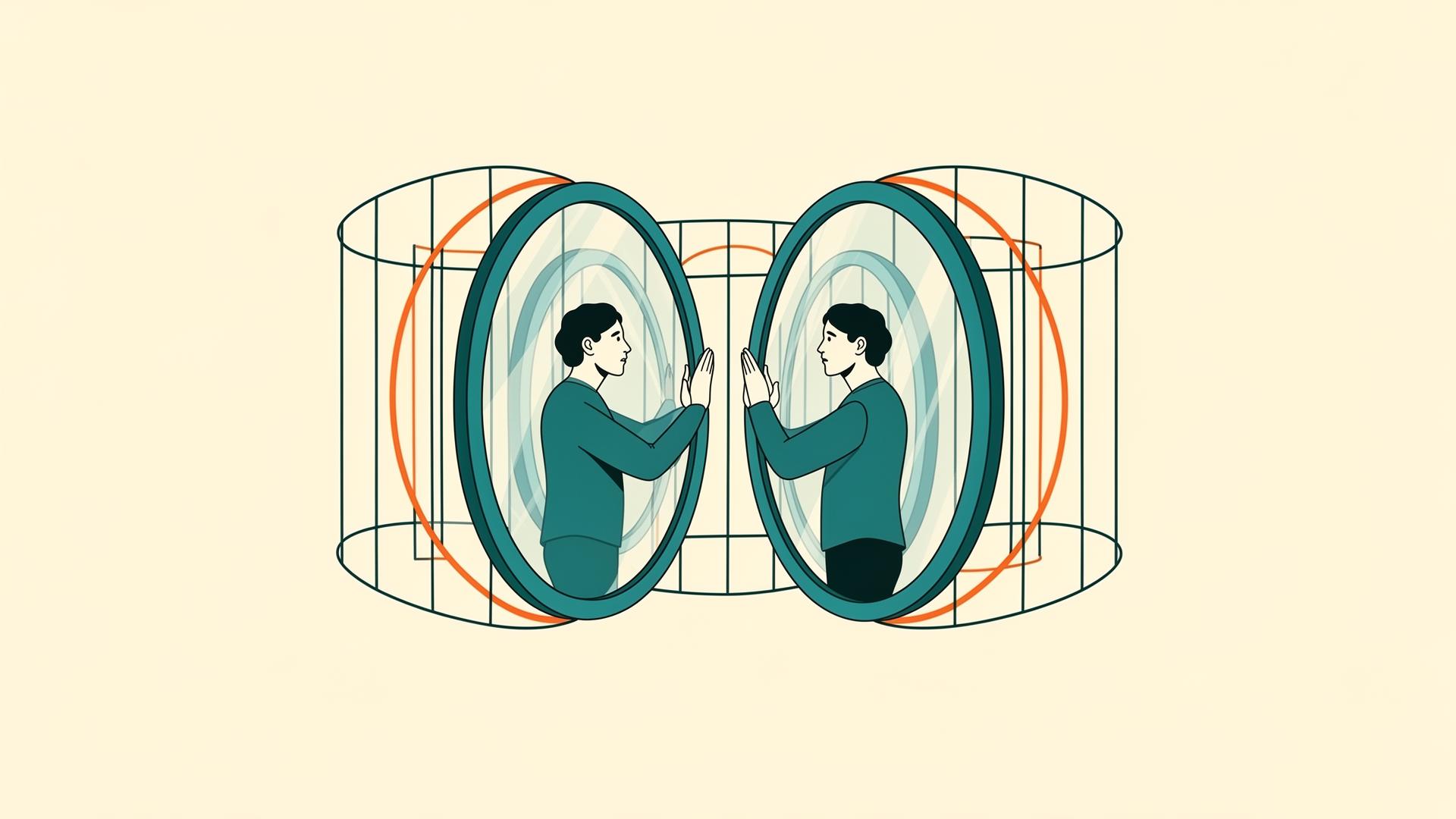
The more I engage in metacognition, the more that very metacognition becomes a new cage. The moment I think, "Not engaging in metacognition is the ultimate metacognition," that itself becomes metacognition.
It ends the moment you put it into words. Like how the moment you say "mushin" (no-mind), you're no longer in a state of no-mind.
There's a Zen saying: "If you meet the Buddha, kill the Buddha." When you encounter the "Buddha" of metacognition, kill even that metacognition. But the moment you try to kill it, a new "Buddha" is born.
I'm completely stuck.
The Salvation in Being Stuck
Is there any salvation in this situation?
Honestly, even seeking "salvation" itself creates a new cage. The very thought that "there must be a way out of this state."
But paradoxically, I also think this:
The very existence of this feeling of being "stuck" might actually be the salvation.
If I were truly detached, I wouldn't feel this uncomfortable. The fact that I'm stuck, uneasy, and going "ugh" means I'm still alive, still moving. Not completely frozen.
I'm uncomfortable with seeing the world too clearly through knowledge. But I can't go back to not knowing. I'm suspended between the two. And that discomfort of being suspended is proof that I'm still "on the way."
Socrates' "knowing that I know nothing." Not that I've achieved detachment, but that I know I'm ignorant. That might be where I stand now.
The Limits of Reason and the Leap of Faith
At this point, I can understand the impulse toward religious return—realizing there's a realm beyond reason's reach and thinking, "Well then, there's only God."
Blaise Pascal, a 17th-century philosopher, said, "The heart has its reasons which reason knows not." Søren Kierkegaard, a 19th-century philosopher, placed the "leap of faith" beyond the limits of reason. But judging rationally that "believing in God is salvation" means you're already caught in the same loop.
Maybe the only option is to abandon words. But writing this in words means it's already impossible.
Endless Suspension
In the end, I didn't arrive at an answer.
It doesn't fully resolve. I can't abandon words. But I'm alive. Still uneasy.
This discomfort might be the price of acquiring knowledge. I can't return to my former naivety. I can only accept it and keep living. Discomfort and all.
Still stuck, yet life goes on.
Bruce Lee said a famous line in the film "Enter the Dragon":
"Don't think. Feel."
...But by "quoting" it, I'm thinking again.

Was this article helpful?

If this article helped you organize your thoughts
a coffee-sized support would be much appreciated.
※ This is separate from tipping, but—
If you'd like to organize similar themes in your own context, I also offer dialogue sessions as a form of thought organization.
Recommended for you