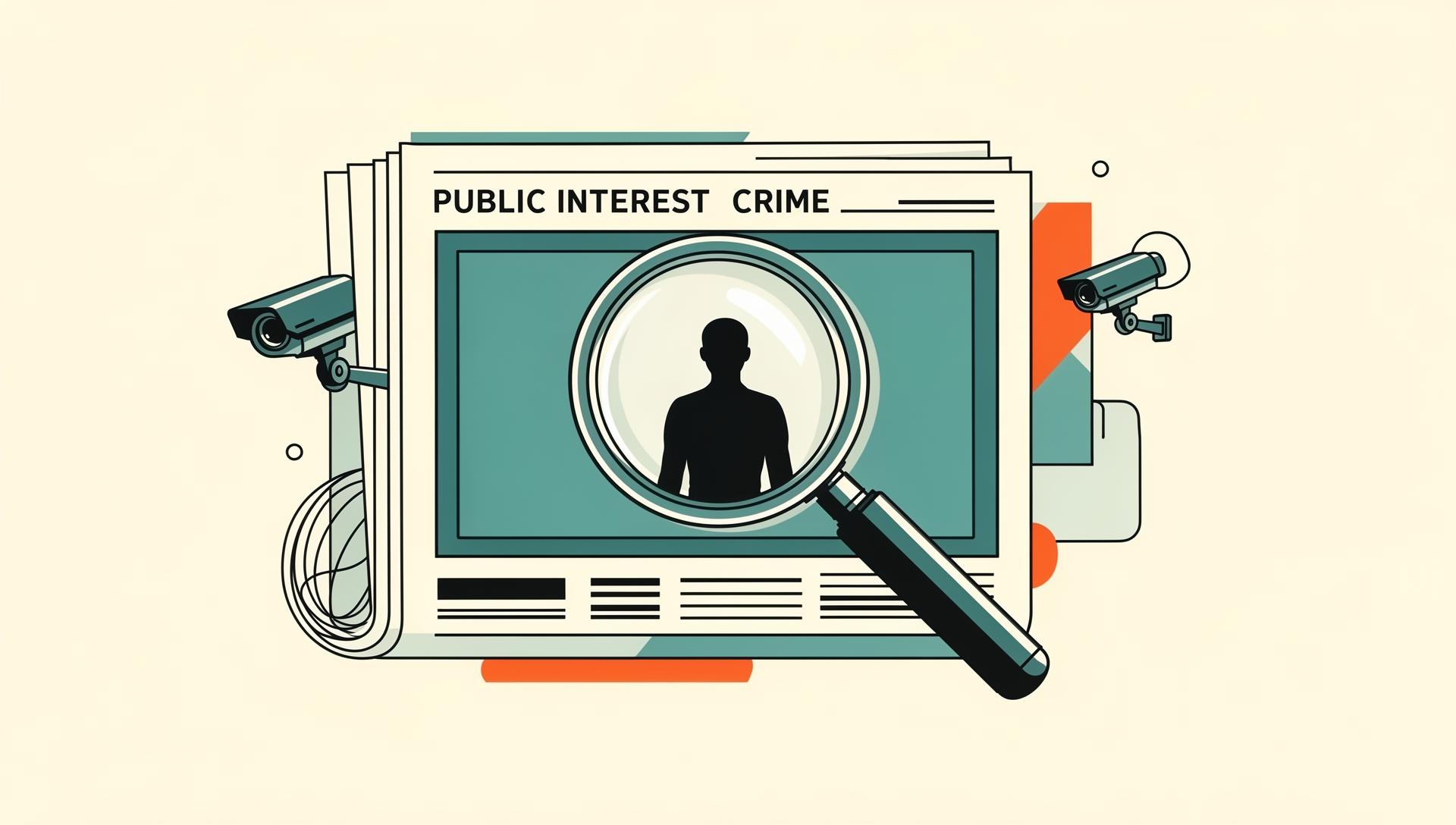
Unease About News Coverage and Reflections on Crime Reporting
Yesterday, I felt uncomfortable watching the news.
A person was arrested on suspicion of murder, and during the coverage, their middle school graduation album photo and excerpts from their graduation essay were shown.
Yes, they were arrested. But is it really necessary to expose someone's past like this? Isn't it a human rights violation? Such thoughts crossed my mind.
It bothered me, so I did some research and tried to organize my thoughts. This might be a bit disjointed, but I'll write it down.
Behind the Word "Public Interest"
Media organizations claim that such reporting has "public interest." They say it's necessary to understand the background of the incident and to serve the public's right to know.
But how much does a middle school graduation essay really relate to a crime committed as an adult? When you think about it calmly, it doesn't quite add up.
Honestly, I can't shake the suspicion that they just want ratings. Voyeuristic curiosity about "what kind of person was the criminal" attracts viewers. The more sensational the information, the more attention it gets. In an advertising revenue model, "being watched" directly translates to profit.
It's hard to deny that the word "public interest" is being used as a convenient justification for commercial motives.
Is There Meaning in Interviewing Classmates?
In the same coverage, they interviewed middle school classmates. Asking if "they seemed like the type to commit such a crime."
But is this information meaningful? I have my doubts.
Middle school is an impressionable age. After 10 years, one's way of thinking and values would have changed considerably. Classmates aren't criminal psychology experts, nor do they accurately remember impressions from 10 years ago.
What's more troublesome is the psychological phenomenon of "hindsight bias." When recalling memories after learning "that person was arrested," human memory unconsciously distorts. "Come to think of it, they seemed dark" or "They were kind of strange." In reality, if you dig into anyone's past, you can find "that kind of episode."
The essence of such interviews, I think, is to construct a "criminal-like" story. To create a narrative of an "evil person" that viewers can accept. But this doesn't help understand the incident; rather, it only reinforces prejudices like "this type is dangerous."
Japan's Reporting Is Unusual Internationally
When I looked into it, reporting graduation albums and essays of suspects is quite unusual internationally.
In Nordic countries (Sweden, Norway) and Germany, suspects are reported anonymously in principle. Even after conviction, they typically remain anonymous. In Germany, suspects in general cases are reported with only the first letter of their family name (e.g., "Marcel H.").
In contrast, the US and Japan use real names as standard, and publish photographs. Japan goes even further, digging into past details.
What's interesting is the recidivism data. Norway's recidivism rate (within 2 years of release) is the world's lowest, around 20%. Meanwhile, the US reports 80%.
Of course, we can't prove a simple causal relationship of "reporting style → crime rate." The low crime rate in Nordic countries is likely due to complex factors like social welfare systems and less economic disparity. Also, Japan's "recidivist rate" and the Nordic "recidivism rate" have different definitions, so simple comparisons require caution.
However, what's suggestive is the "difference in philosophy."
In Nordic countries, emphasis is placed on "healing rather than punishing." On the premise that criminals will return to society, stigma is minimized. In Japan and the US, exposure and social sanctions are used as deterrents. As a result, this makes social reintegration difficult and may even lead to recidivism.
There's no evidence that exposing the past in reporting contributes to crime prevention; it might even be counterproductive. Thinking this way raises questions about Japan's current reporting practices.
Historical Roots of "Exclusion"
Japan's attitude toward criminals seems to have historical and cultural backgrounds.
Exile to islands wasn't just isolation but held symbolic meaning of "cutting off from society." "Murahachibu" (village ostracism) was a custom of excluding those who broke community rules, involving not just the individual but their family as well.
There's also the notion of "impurity." Criminals are seen as "impure beings," and even associating with them is avoided. This is part of the background for discrimination against criminals' families.
The often-mentioned "culture of shame" may also be related. In a society where "public eyes" are the standard, "being exposed to the public" itself becomes the maximum punishment. That's why media have no hesitation in "exposing," and viewers feel "they deserve to be exposed."
Television exposing even graduation albums today might be a modern version of this history.
The Perspective That "Anyone Could Become a Criminal"
Thinking this far, I realized something important.
Even people living ordinary lives could become criminals through some mishap.
Even with the utmost care in driving, you can cause a traffic accident. It depends on your mental and physical state at the time. If arrested for involuntary manslaughter, from that moment you could be reported as a "suspect." Someone who was living normally just yesterday.
False accusation cases are even more serious. Lives are destroyed despite doing nothing wrong. Media damage doesn't recover even if acquitted.
The premise that "I will absolutely never be on that side" allows throwing stones from a safe place. Current reporting seems to have this structure. But in reality, anyone could go to "that side."
That's precisely why we need to establish minimum standards through law as rules, rather than through emotion or ratings.
Unchanged for 40 Years
When I looked into it, this problem has been pointed out for over 40 years.
The Japan Federation of Bar Associations adopted the "Declaration on Human Rights and Reporting" in 1987, calling for "expanding the scope of anonymity toward realizing anonymity in principle." Former Kyodo News reporter Kenichi Asano published "Crimes of Crime Reporting" in 1984, criticizing the real-name reporting principle and sparking debate.
However, almost nothing has changed. Some aspects have even worsened. The 2022 Juvenile Act amendment lifted the ban on real-name reporting for 18 and 19-year-olds ("specified juveniles") when they are prosecuted.
Why hasn't it changed?
There are criticisms of the media industry as a "closed village society." Critical voices are excluded, and self-purification doesn't work. External regulation is rejected using "freedom of the press" as a shield. Unless there's citizen voice or public opinion change, the prospect of voluntary change seems slim. Such a structure appears to exist.
Questions to Keep in Mind
In Germany and Sweden, anonymous reporting of suspects is mandated by law and press council regulations. Yet freedom of the press still functions. The balance of "protecting freedom of the press while also protecting individuals' privacy" should be possible with proper institutional design.
Is Japan's current reporting practice really acceptable as it is?
Aren't we justifying exposing someone's life irreversibly with the word "public interest"?
Whether we can imagine "ourselves who might become criminals" - this might be one measure of a society's maturity.
I don't have an answer, but I'll remember this unease.
Related Books
"Crimes of Crime Reporting" by Kenichi Asano, mentioned in this article, is a book that deeply explores the problems of crime reporting. For those who want to learn more about media ethics, the following books are also recommended.
References
- Declaration on Human Rights and Reporting (1987) - Japan Federation of Bar Associations
- Juvenile Act Changes! - Ministry of Justice
- Cutting-edge Nordic Victim Support and Criminal Rehabilitation - Bengo4.com News
- Real Name Reporting: Japan Media's Landing Point? - Yahoo! News
- "Crimes of Crime Reporting" - Kodansha BOOK Club
- Kenichi Asano Interview - BOOKSCAN
Was this article helpful?

If this article helped you organize your thoughts
a coffee-sized support would be much appreciated.
※ This is separate from tipping, but—
If you'd like to organize similar themes in your own context, I also offer dialogue sessions as a form of thought organization.
Recommended for you