From J.League News to Design Philosophy
This might end up being a somewhat disjointed piece.
But I felt compelled to record this sense of "connection" that happened within me.
It all started with a J.League season shift news story that happened to be on TV. My initial reaction was just "huh, things are changing." But when I dug a little deeper, I found it surprisingly profound, and before I knew it, I'd spent hours thinking about it.
In this article, I want to preserve my chain of thought exactly as it unfolded from that single news item.
The Fact: The Season Is Changing
First, let me establish the context.
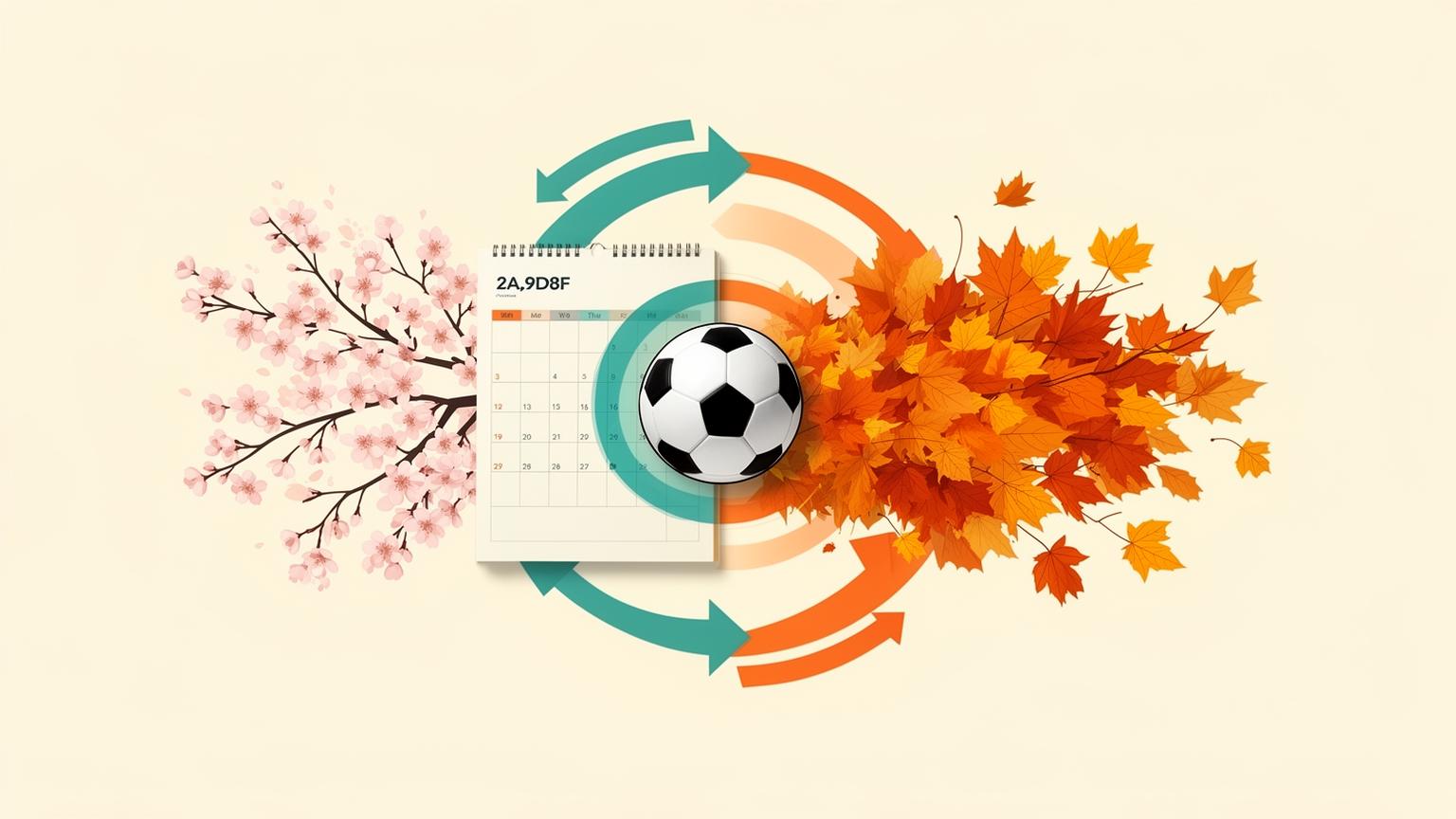
From the 2026-27 season, the J.League will shift from the current "spring-autumn system" (February start → December end) to an "autumn-spring system" (August start → May-June end the following year). In other words, they're aligning with the European league calendar.
At first, I thought "okay, they're just matching Europe." But when I started asking "why now?" and "what actually changes?", I discovered far more interconnected elements than I expected.
Following "Why" Led to Economics
Looking into the reasons for the season shift, several factors emerged.
Aligning with the European transfer market calendar to increase transfer fee revenue. Eliminating the schedule mismatch with the ACL (Asian Champions League). Reducing the number of matches during extreme heat.
All rational. But what caught my attention was the numbers behind these reasons.
The J.League has set a goal to increase all clubs' combined revenue by 1.5 to 2 times over the next decade. The 2024 total revenue (60 clubs combined) is approximately 172.5 billion yen. The plan is to reach 225-300 billion yen by 2033. Meanwhile, they're projecting a 4.3 billion yen deficit during the transition period and need 10 billion yen in investment to support clubs in snowy regions.
In other words, this season shift is a decision that comes with significant short-term pain. Yet they're doing it anyway. Not with vague hopes of "it'll pay off someday," but with clear numerical targets and firm commitment. I found that quite powerful.
The Relationship with Baseball Revealed a "Coexistence" Philosophy
Next, I got curious about the relationship with professional baseball.
Under the current spring-autumn system, NPB (March-October) and J.League (February-December) seasons almost completely overlap. They compete for the same limited resources—sponsors, media attention, fans' time and money—during the same period.
With the autumn-spring shift, league matches will take place during baseball's off-season. They won't completely separate, but peak periods will be distributed. What struck me here was that this isn't a passive story of "avoiding competition," but closer to "expanding the overall pie of Japan's sports market."
And when I looked into the NPB-J.League relationship, I found that rather than "rivalry," it's positioned as "the two wheels of Japanese sports." During the COVID-19 pandemic, they established a joint countermeasure liaison meeting, holding 68 meetings. They issued a joint message stating "Professional baseball and J.League are the two wheels of sports culture in Japan."
Not competition, but coexistence. From here, my interest shifted to "the structure of sports business" itself.
Two Models: America and Europe
This is where it got really interesting for me.
America's four major leagues (NFL, MLB, NBA, NHL) have exquisitely staggered seasons. Their "peak periods" are distributed throughout the year, so there's always a major season happening. Moreover, the climaxes are beautifully spread out—NFL's Super Bowl (February), MLB's World Series (October), NBA Finals (June).
What's even more interesting is that the same owners often hold teams across multiple leagues. This structural factor encourages "coexistence" rather than "conflict."
On the other hand, what about Europe? European sports economics is almost completely dominated by football. The European football market in the 2023/24 season was 38 billion euros (about 6 trillion yen). Other sports—F1, rugby, tennis—exist, but the economic scale difference is enormous.
This happens because Europe has football leagues in each country, plus a two-tier structure where they compete across borders in the Champions League. Additionally, the promotion-relegation system incorporates regional clubs from the grassroots level, making it culturally very deeply rooted. There's almost no room for other sports to enter.
Then it hit me.
Japan has both of these models coexisting within a single country.
NPB (professional baseball) follows the American franchise system. No promotion-relegation, fixed number of teams, corporate names as team names. The philosophy of stability and investment protection.
J.League follows the European promotion-relegation system. Regional names as club names, hometown system, expansion from 10 to 60 clubs. The philosophy of competition and regional expansion.
This didn't happen by accident.
For those interested in learning more about the structural differences in sports business across countries, this book offers valuable insights.
The Perspective of Different Design Philosophies
NPB's closed system came about because baseball was a sport imported from America. It took the form of "corporate sports" with parent company names as team names, eliminating relegation risk to protect investments.
Meanwhile, J.League's first chairman, Saburo Kawabuchi, is said to have designed it explicitly as a "counter-example" to NPB. He had concerns about the risk of teams disappearing if parent companies struggled financially, and the weak connection to regions through corporate names. He established the "100-Year Vision"—a vision to root sports culture in regions that would last 100 years.
There was also clear reasoning for implementing the promotion-relegation system. If you close off the top league, small clubs in rural areas lose the dream of "aiming higher." With promotion-relegation, even a J3 club has the possibility of reaching J1. This design was intended to spread football culture nationwide.
I was genuinely impressed here.
It's not about which is correct, but rather designing the system backward from "what matters most." NPB prioritizes "stable entertainment business," while J.League prioritizes "expanding regionally-rooted sports culture." Each design philosophy shapes the form of the league.
To learn more about the background of Saburo Kawabuchi's J.League design and the full scope of his philosophy, this book provides detailed insights.
The 100-Year Vision League—Meaning in a Name
Here's another moment when things connected.
With the season shift, a one-time special tournament will be held in the first half of 2026. Its name is "Meiji Yasuda J.League 100-Year Vision League."
When I first heard it, I thought "huh, okay." But after all this context, I realized significant intention is embedded in this name. At this historic turning point of abandoning the 30-year spring-autumn system, they're deliberately crowning it with their founding principle. The message is "this isn't just a calendar change, it's evolution toward the next 100 years."
Moreover, the tournament format aligns with the 100-Year Vision spirit—not just J1, but all 60 clubs from J1, J2, and J3 participate, divided into eastern and western regional blocks. The philosophy of "rooted in regions" is directly reflected in the tournament design.
Following one news story, I found that the founding philosophy, model selection, and management strategy were all connected in a continuous line. It felt like puzzle pieces clicking perfectly into place.
For a deeper understanding of the 100-Year Vision and how "sports culture can transform a nation," this book offers comprehensive coverage.
The Three-Layer Structure J.League Envisions
What ultimately emerged was the three-layer structure of J.League's worldview.
The first layer is "becoming a league that can compete globally." Connecting with Europe through season shift, expanding transfer fee revenue, full participation in ACL and Club World Cup. This is the economic strategy layer.
The second layer is "circulation from regional to global." Because there are clubs loved by their regions, players develop, sponsors gather, and they can compete globally. The results from global competition are returned to the regions, further developing the clubs. This is the circulation layer.
The third layer is "sports culture infrastructure beyond football." What the 100-Year Vision ultimately aims for isn't just the success of a football league, but using football as an entry point to root the culture of regional sports clubs throughout the nation. This is the social transformation layer.
The season shift is a piece of the "compete globally" part. The 100-Year Vision League is a tournament symbolizing this turning point. And beyond that lies the question of society itself through sports.
What I Take Away from This Exploration
Honestly, I'm not particularly knowledgeable about football. But what I strongly felt from this exploration is that when you dig into the "why" of a single news item, you inevitably reach the design philosophy behind it.
Season changing → why → economic rationality → but that's not all → structural differences → philosophical differences → 100-year vision.
This chain-like exploration itself was the learning for me. Instead of just letting news pass by with "huh," try adding just one "why." The scenery you see will completely change.
And the fact that two models—NPB and J.League—coexist within the same country. American-style stability and European-style competition. It's not about which is right, but rather "what matters most" comes first, and the system emerges as a result.
This sequence of "design philosophy first, system follows" might apply to many situations beyond sports.
Have you recently let a news story pass by with just "huh"?
Try adding just one "why," and you might discover an unexpected landscape.
References
- 【Official】About Season Shift from 2026-27 Season - J.League
- J.League 2025 Business Plan (Revenue target 225-300 billion yen, etc.)
- 2024 Club Management Information Disclosure (Official Announcement) - J.League
- What Changes in J.League 2026? - Goal.com Japan
- NPB and J.League Form Unprecedented Partnership. COVID-19 Countermeasure Liaison Meeting Report - J.League Official
- Report on COVID-19 Response Summary (Regular meetings ended after 68 sessions) - J.League Official
- NPB COVID-19 Response Summary (2020-2022)
- Deloitte Annual Review of Football Finance 2025: European football market €38 billion
- J.League Autumn-Spring System - Wikipedia
- History | About J.League - J.League Official
- J.League Club Management Guide 2025
Was this article helpful?

If this article helped you organize your thoughts
a coffee-sized support would be much appreciated.
※ This is separate from tipping, but—
If you'd like to organize similar themes in your own context, I also offer dialogue sessions as a form of thought organization.
Recommended for you