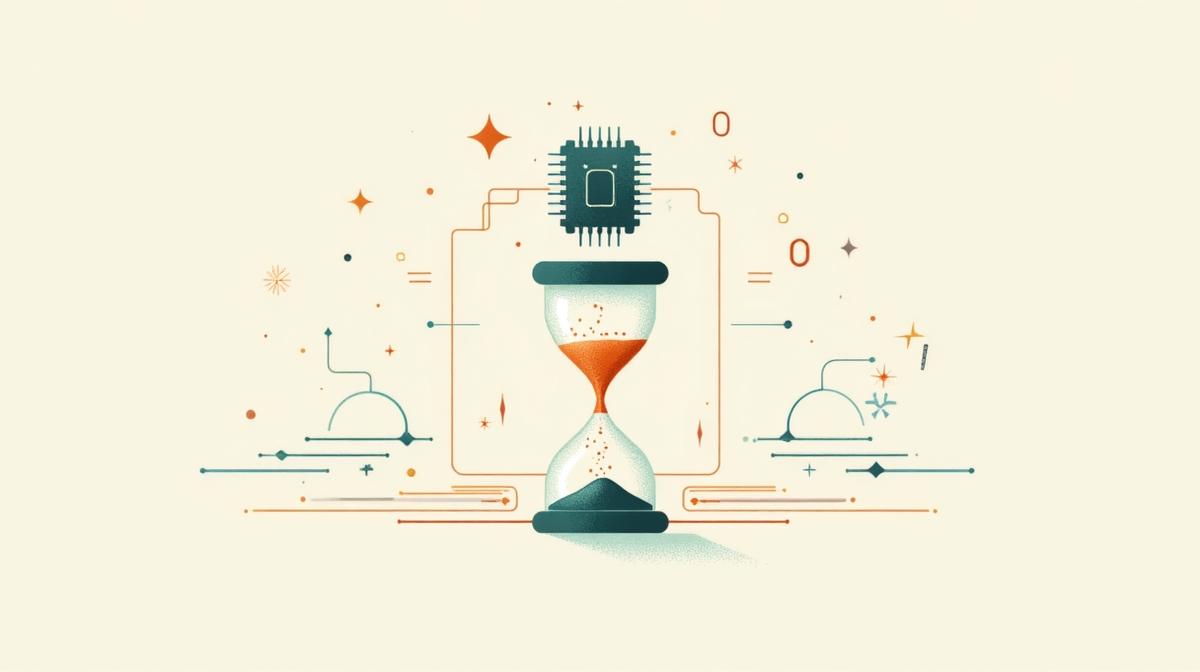
What Are We Consuming Every Time We Use ChatGPT?
Recently, I've been seeing more and more news about "AI companies' power consumption problems" on News Picks and other media outlets. Stories about OpenAI posting massive losses, data center power demands surging rapidly, and so on.
I personally use the Claude API daily for RefCla development. Code reviews, text refinement, bouncing ideas around. I'm someone who benefits greatly from AI. That's precisely why I felt I needed to properly understand what's happening behind the scenes.
So I decided to ask Claude: "Tell me more about the AI power supply problem."
The answer that came back was more complex—and heavier—than I had imagined.
OpenAI and Anthropic Are Actually in the Red
The first thing that surprised me was the revenue structure of AI companies.
OpenAI's projected 2025 revenue is about $13 billion, but compute and engineer salaries alone are expected to consume about 75% of that revenue. Looking more closely, inference costs (actual service operations) alone consumed $3.76 billion in 2024. That's roughly equal to their revenue at the time. And by September 2025, it's said to have doubled.
Anthropic is similar. Their projected 2025 revenue is about $2.2 billion, but their cash burn is about $3 billion. In other words, costs exceeding their revenue are being generated.
Some estimates put ChatGPT's operating costs at about $700,000 per day (approximately 100 million yen), with electricity costs accounting for most of that. For GPT-3 training, 60% of the cost was electricity.
In short, AI companies are currently operating at a loss.
Investors Are Betting With Full Knowledge
So why do investors continue to pour in massive amounts of capital?
When I looked into it, I found that opinions are sharply divided among investors.
Major financial institutions like Goldman Sachs and Morgan Stanley argue that "this is not a bubble but growth backed by substance." Compared to the dotcom bubble era, they say current AI companies have healthier financials and are generating actual revenue.
On the other hand, many investors and analysts are expressing serious concerns. In August 2025, according to an MIT Media Lab report, despite $30-40 billion in investment in enterprise AI, 95% of organizations saw zero return.
What's interesting is that investor interest is shifting from "AI companies themselves" to "energy infrastructure." According to a BlackRock survey of 732 clients, only one-fifth of respondents viewed major tech companies as attractive investments. Meanwhile, more than half said data center energy was promising.
In other words, smart investors understand: In the "AI Gold Rush," it's not the gold diggers who profit, but those who provide the tools and peripheral services.
Harvard Business School Professor Andy Wu put it this way: "OpenAI, Anthropic, and xAI are digging for gold, but Nvidia is selling shovels, and Meta is a jeweler. Microsoft, Amazon, and Google aren't fixated on gold digging."
The Weight of 8,000 Years
So how will the power supply problem be solved?
In the short term, SMRs (Small Modular Reactors) are getting attention. Google, Amazon, Microsoft, and others have already signed power purchase agreements with development companies, aiming for operation around 2030. They're smaller than conventional reactors, can be installed near data centers, and function as stable power sources.
In the medium to long term, fusion power is considered the main contender. 2025 has become a historic turning point for fusion, with private companies collectively investing over $8 billion. The Japanese government has also set a goal of demonstration in the 2030s. Fusion is an ideal energy source: priced similarly to current nuclear power, virtually inexhaustible, safe, and producing almost no high-level radioactive waste.
However, there's an important problem here.
High-level radioactive waste from conventional nuclear power takes about 8,000 years for radioactivity to reach natural uranium levels, and tens of thousands of years to reach uranium ore levels.
This problem has not been completely solved.
Internationally, "geological disposal" (burial in stable bedrock more than 300 meters underground) is recognized as the optimal method. In Japan, document surveys are currently being conducted in Suttsu and Kamoenai in Hokkaido, and Genkai Town in Saga Prefecture, but no final disposal site has been decided.
And there's fierce disagreement on this issue.
Those promoting nuclear power argue that "it's generational responsibility for the current generation to establish a disposal path and minimize the burden on future generations as much as possible."
On the other hand, the Japan Federation of Bar Associations declared in a 2022 resolution that "with current scientific and technical knowledge, it is difficult to perform geological disposal in Japan that can ensure safety for the future for high-level radioactive waste that has strong radioactivity for a long period."
Over 300 earth science experts also issued a statement saying "it is impossible to select a location in Japan, which is situated in a crustal deformation zone, where waste can be confined underground for 100,000 years."
8,000 years. A mere instant in Earth's 4.6 billion year history, but an unimaginable length on human timescales.
8,000 years ago was the Jomon period. Egyptian civilization didn't even exist yet. 100,000 years ago was the era of Neanderthals.
How should we receive the weight of this time?
Documenting the Decision-Making Process
Through this dialogue, what made me think the most was this point.
There are those who insist on not passing current generation problems to the next generation, and those who think it's fine to take time as long as the problem can be solved. Both arguments exist.
My own thinking is that if there's a prospect of solving it through innovation, it might be acceptable to take some time. Solar energy has the potential to provide over 50 times humanity's needs, and it's technically quite feasible. If fusion proceeds smoothly, it could be commercialized by 2050.
However, there are conditions.
We who are living now need to leave behind for posterity how we were thinking about the best methods conceivable at the time and how we made our decisions. I believe that is our responsibility.
This is exactly the concept of "reflection" that I value. In the ORIMD framework, it corresponds to "D (Decision)." Not just what was decided, but why it was decided, what facts existed, how they were interpreted, and what meaning was found.
Leaving that record. Making it possible for future generations to look back. Isn't that the responsibility of the current generation?
Keeping Our Attention Focused
We can no longer return to an era without AI's benefits.
That's precisely why I felt it's important to keep paying attention to energy issues.
For example, it might be good if we could visualize how many watts of electricity a single LLM execution consumes. Just as we're conscious of smartphone battery remaining, if we could become aware of AI's power consumption, perhaps our usage would change too.
Knowing the fact that even among investors, opinions are divided. Recognizing that this is not a problem with easy answers.
Answers won't come immediately. But I think continuing to ask questions is what matters.
What do you think?
References
SMR (Small Modular Reactor) Related
- Mitsubishi Research Institute "What value do Small Modular Reactors (SMRs) bring to Japan?"
https://www.mri.co.jp/knowledge/column/20250729.html
- Kuklev Gateway "What is SMR (Small Modular Reactor)?"
https://rokemoba.com/column/smr-market-ai-communication-2025/
- JETRO "Google, Amazon announce power purchases from small modular nuclear reactors"
https://www.jetro.go.jp/biznews/2024/10/9f4e0fc76c0a2f04.html
Fusion Power Related
- Asuene "Is fusion power commercialization possible? Explanation of challenges and latest trends"
https://asuene.com/media/1563/
- Nikkei Business "Fusion commercialization competition intensifies: Global trends and what Japan should do"
https://business.nikkei.com/atcl/gen/19/00081/010700742/
- Canon Institute for Global Studies "Fusion power is the trump card for climate action: Japan should lead the world toward 2050 commercialization"
https://cigs.canon/article/20240109_7828.html
High-Level Radioactive Waste / Geological Disposal Related
- Ministry of Economy, Trade and Industry, Agency for Natural Resources and Energy "Toward appropriate disposal of radioactive waste"
https://www.enecho.meti.go.jp/about/special/johoteikyo/final_disposal.html
- Japan Federation of Bar Associations "Resolution calling for review of high-level radioactive waste geological disposal policy and realization of sustainable society responsible to future generations"
https://www.nichibenren.or.jp/document/civil_liberties/year/2022/2022_1.html
- Science Council of Japan "On the disposal of high-level radioactive waste"
https://www.scj.go.jp/ja/info/kohyo/pdf/kohyo-22-k159-1.pdf
Solar Energy Related
- Wikipedia "Solar energy"
https://ja.wikipedia.org/wiki/太陽エネルギー
- AIST "Solar power generation resources"
https://unit.aist.go.jp/rpd-envene/PV/ja/about_pv/e_source/esource_2.html
AI Company Finances / Investor Perspectives
- MIT Technology Review "What even is the AI bubble?"
https://www.technologyreview.com/2025/12/15/1129183/what-even-is-the-ai-bubble/
- Harvard Gazette "Should U.S. be worried about AI bubble?"
https://news.harvard.edu/gazette/story/2025/12/should-u-s-be-worried-about-ai-bubble/
- McKinsey "The cost of compute power: A $7 trillion race"
https://www.mckinsey.com/industries/technology-media-and-telecommunications/our-insights/the-cost-of-compute-a-7-trillion-dollar-race-to-scale-data-centers
- Sacra "OpenAI revenue, valuation & funding"
https://sacra.com/c/openai/
- Sacra "Anthropic revenue, valuation & funding"
https://sacra.com/c/anthropic/
Was this article helpful?

If this article helped you organize your thoughts
a coffee-sized support would be much appreciated.
※ This is separate from tipping, but—
If you'd like to organize similar themes in your own context, I also offer dialogue sessions as a form of thought organization.
Recommended for you