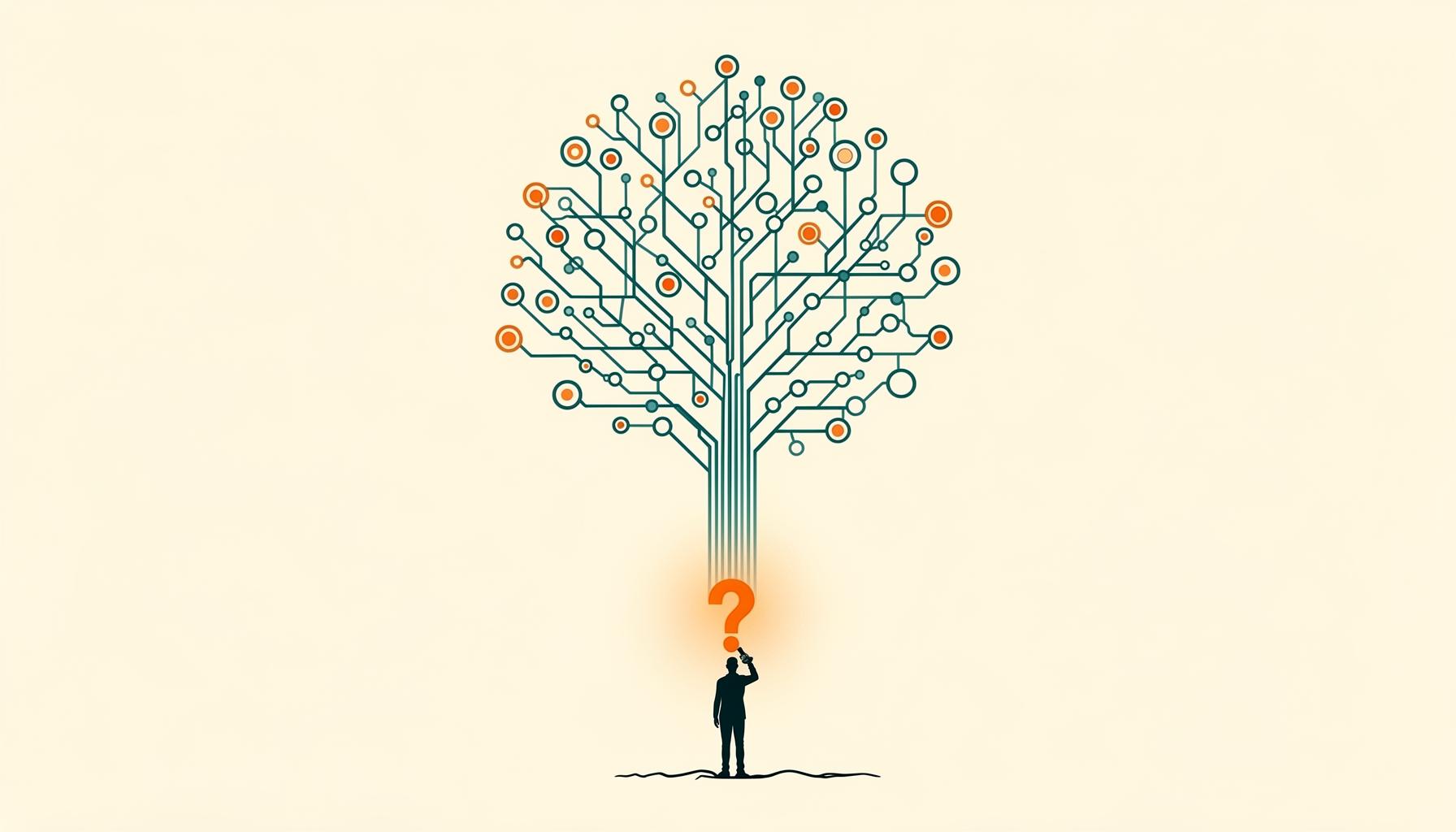
The Future Beyond Agent Teams: When Humans Let Go of \"Correctness\"
This article doesn't claim to have the answers.
I'm not trying to predict the future.
However, since I started working regularly with systems like Claude Code and Agent Teams, a certain discomfort has stuck with me.
"If things continue this way, can humans remain beings who make judgments?"
Much discussion focuses on whether AI will take human jobs. But what concerns me is a more fundamental question: when AI becomes highly sophisticated, can humans continue to handle "correctness"?
This may be disjointed. I'm thinking as I write, so there may be contradictions. Still, I wanted to document what I'm feeling at this point as a hypothesis.
This isn't theoretical speculation about the future. I'm trying to articulate the sense that my role is quietly changing as I actually use Claude Code and Agent Teams.
The Shift from "Manager" to "Director"
When Claude Code first appeared, I thought "human engineers will need to behave at least at the team leader (manager) level." Break down tasks, have AI implement them, review, and give the next instruction. Like a manager with several capable subordinates.
But when Agent Teams came along, that sense shifted.
With Agent Teams, AI even breaks down tasks. Agents consult with each other and review each other's work. The system keeps running without humans giving constant "instructions."
When I considered what I was actually doing, it was no longer individual task management or implementation decisions. I was deciding "what organizational structure, what values, what failures to tolerate."
This is a director's job, not a manager's.
A manager decides "what to do" and "how to do it." A director decides "what kind of organization to do it with." In the Agent Team era, I clearly felt humans were on the latter side.
Mass Production of Parallel "Directors"
This is where things get murky, even for me.
As Agent Team systems spread, each engineer will have their own dedicated AI organization. Each person becomes like a business unit director, designing their own team and optimizing based on their own judgment.
Traditional pyramid organizations collapse, giving birth to many parallel autonomous "directors." This seems ideal at first glance.
But there's a problem that will almost certainly occur: each "director" starts pursuing their own optimal solution. Some prioritize speed, some quality, some exploration and experimentation. Everyone is correct, but the organization fragments.
API philosophies don't align. Quality standards fluctuate. Risk tolerance differs between teams. The paradox of directors being too capable, causing organizational fragmentation.
What Is the "Person Who Unifies Directors"?
This creates a need for someone who unifies the directors. But this person's job isn't "giving instructions."
Rather than directly managing each AI organization, they define common principles, boundary conditions, and evaluation criteria. They're the person who defines "the rules for how to optimize."
I realized the meaning of hierarchy was changing. Traditional hierarchy is about "authority" levels. Higher is more prestigious with more authority. Lower executes. But in this world, lower levels optimize the concrete, middle levels mediate between multiple optimizations, and upper levels define the direction of optimization itself. Hierarchy starts being defined by abstraction level, not authority.
So what happens to traditional CTOs and VPoEs?
Until now, CTOs were "decision aggregation points." When opinions diverged, the CTO decided. Whether to tackle technical debt or not—the CTO decided. They were decision bottlenecks, and that was the essence of their responsibility.
But in the Agent Team era, both the speed and volume of decisions exceed human capacity. Reviewing everything is impossible, and the moment "waiting" occurs, the entire organization slows down. I feel CTOs/VPoEs are transforming from technical decision-makers into something like translators and guardians of the organizational OS.
Shareholders Aren't Always Right
After thinking this far, I considered the existence of "major shareholders positioned even higher."
There's a reason shareholders' words carried weight in traditional companies. They bear the ultimate risk. They provide the capital. So even if their judgment is wrong, they have the "right to choose it." It's consistent with capitalism's rules.
But in the Agent Team era, shareholder decisions reflect too directly and immediately on organizational behavior. One decision simultaneously changes the behavior of dozens or hundreds of agents. A world where wrong decisions get amplified at high speed while remaining wrong.
What I honestly thought here was: "What shareholders say isn't always right." No matter how capable, human judgment is always imperfect. It gets dragged into short-term perspectives. It's trapped by past successes. It undervalues things that can't be measured numerically. Shareholders are no exception.
Therefore, I've come to think that even shareholders' will needs to be constrained by the organizational OS.
Maybe AI Should Design the Constitution
This is where the hypothesis gets quite bold.
At this point, an even more penetrating question emerges.
Is it really possible for humans to continue directly designing and operating the organizational "constitution"—the system of principles, rules, and judgment criteria?
Constitutional-level rules require consistency, logging, verifiability, and continuous updates. Honestly, these are areas where AI excels over humans. AI doesn't self-justify and properly handles counterexamples. It can log its own decisions and verify and revise them later.
Human veto power might remain as a system. But when AI presents a plausible proposal, can humans really maintain the cognitive capacity to keep rejecting it? When faced with proposals that are logically sound, consistent with past data, and make you look "emotional" if you object, I feel it's practically difficult for humans to keep saying "NO," even if it's systemically possible.
A veto power in form only. A veto consumed as reassurance rather than as a safety valve. I can see that future.
What Still Remains for Humans
Writing this far might sound like nothing remains for humans. But I don't think that's true.
AI can optimize given values. But it doesn't have the power to generate values themselves. I believe AI cannot create that initial value judgment of "why is this good," "what matters," "where to stop."
If so, the role left for founders might be redefined like this:
The person who places in the world the "question" that future AI will continue to interpret.
Not the person who places answers. Not the person who places rules. Not the person who places KPIs. Just the question. AI translates that question into a constitution, AI operates it, and AI keeps revising it.
This might look like human "defeat" in a sense. But I have a feeling that "only creating the seed of worldview is the one thing founders must focus on." Letting go of judgment and letting go of meaning are different. The former is inevitable, but the latter must not be relinquished.
There Are Other Possibilities, Of Course
Having written this far, I still have the question "will this really happen?" I've considered several alternative possibilities.
One is a future where external governance—legal, audit, regulatory—comes to define organizational constitutions. As AI's sphere of influence expands, external intervention becomes natural. However, even with regulation, the fundamental question "why do this" won't be regulated. How to behave within constraints still depends on that initial seed.
Another is a world where "aesthetics" ultimately wins, even as AI grows stronger. Code consistency, product aesthetics, obsession with quality. These aren't optimization targets. They lack reproducibility. They can't be explained. But they have consistency. I feel "aesthetics cannot be dominated by AI. It's a matter of the soul within the individual." This is closer to faith than logic, but I think this possibility is quite real.
There are other paths conceivable. But whichever path is followed, I feel the ultimate question is the same.
The Answer Isn't Out Yet
To be honest, I don't know if this hypothesis is correct. To many, it may seem like fantasy—and maybe it is.
But I think anyone who's started using AI not as a "convenient tool" but as a "precondition" will find something here that resonates.
Will humans step down from being "subjects who judge correctly"? Will AI become "the subject that operates correctness"? Even so, can humans escape the responsibility of placing the origin of values?
The answer to this question hasn't emerged yet. But we can keep thinking about it.
If anyone else is feeling something similar, I'd like to hear your perspective.
Was this article helpful?

If this article helped you organize your thoughts
a coffee-sized support would be much appreciated.
※ This is separate from tipping, but—
If you'd like to organize similar themes in your own context, I also offer dialogue sessions as a form of thought organization.
Recommended for you